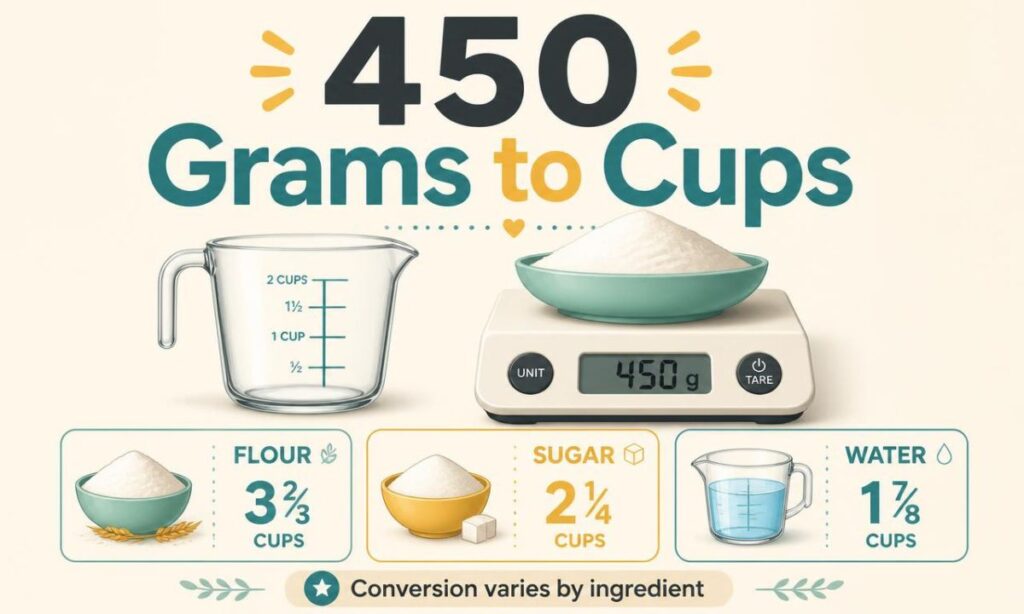
Have you ever started baking a cake, preparing cookies, or mixing your favorite recipe, only to discover that the ingredients are measured in grams while your measuring cups are sitting right beside you? It happens more often than you might think. A recipe may ask for 450 grams of an ingredient, and suddenly, a simple kitchen task turns into a little measurement puzzle.
The good news is that converting 450 grams to cups is fairly easy once you understand how grams, cups, and ingredient density work together. Whether you’re measuring water for a recipe, flour for homemade bread, sugar for cookies, or butter for a delicious dessert, the right conversion can save time and help you achieve better results.
However, there’s one important detail to remember: 450 grams does not always equal the same number of cups. Grams measure mass, while cups measure volume. Since different ingredients have different densities, 450 grams of flour occupies a different amount of space than 450 grams of water or honey.
In this guide, you’ll learn how many cups are in 450 grams, how to use a grams to cups converter, which formulas make conversions easier, and how to measure common ingredients accurately without making your kitchen feel like a science laboratory.
How Many Cups Is 450 Grams?
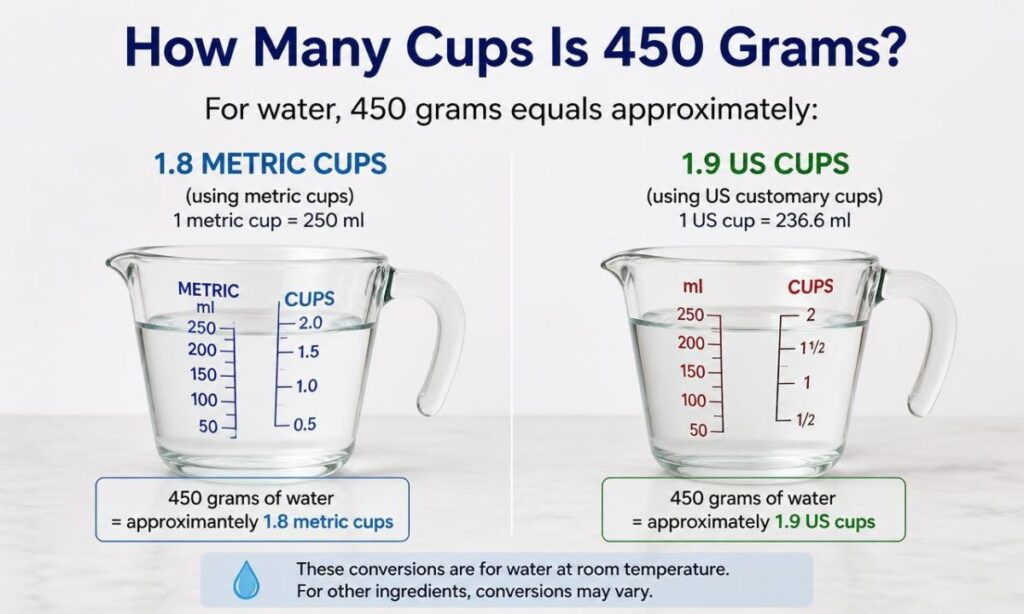
The answer depends on the ingredient you’re measuring and the type of cup used in your kitchen.
For water, 450 grams equals approximately 1.8 metric cups, assuming one metric cup holds 250 milliliters. When using US customary cups, which hold approximately 236.6 milliliters, 450 grams of water equals about 1.9 US cups.
Here’s a quick reference to help you understand the basic conversion.
| Measurement | Equivalent |
|---|---|
| 450 grams | 0.45 kilograms |
| 450 grams of water | 450 milliliters, approximately |
| 450 grams of water in metric cups | 1.8 cups |
| 450 grams of water in US cups | 1.9 cups |
| 1 metric cup | 250 milliliters |
| 1 US cup | Approximately 236.6 milliliters |
| 1 liter | 1,000 milliliters |
These figures are useful starting points, especially when a recipe calls for a liquid ingredient. Dry ingredients require a little more attention because their weight changes according to how tightly they’re packed into a measuring cup.
For example, a cup of flour usually weighs much less than a cup of honey. Both may fill the same measuring container, but they don’t contain the same mass.
So, if you’re asking, how many cups is 450 grams?, the most accurate answer begins with another question: 450 grams of what?
450 Grams to Cups Conversion Chart
A conversion chart is one of the easiest ways to switch between metric measurements and kitchen volume measurements. Instead of working through a formula every time you cook, you can check the ingredient you’re using and estimate the required number of cups.
The following chart provides approximate values for common ingredients. Actual measurements can vary with ingredient type, moisture content, packing method, and the cup standard.
| Ingredient | Approximate weight per metric cup | 450 grams in metric cups |
|---|---|---|
| Water | 250 g | 1.8 cups |
| Milk | 258 g | 1.74 cups |
| All-purpose flour | 125 g | 3.6 cups |
| Granulated sugar | 200 g | 2.25 cups |
| Brown sugar, packed | 220 g | 2.05 cups |
| Butter | 227 g | 1.98 cups |
| Cooking oil | 230 g | 1.96 cups |
| Honey | 350 g | 1.29 cups |
| Cornstarch | 125 g | 3.6 cups |
| Cocoa powder | 100 g | 4.5 cups |
These are practical estimates, not universal conversion values. Different flour varieties, sugar crystals, and ingredient brands can produce different results. Use the product label or a reliable ingredient-specific conversion chart when precision matters.
Notice how much the measurements differ. While 450 grams of water fits into fewer than two metric cups, the same weight of cocoa powder may occupy several cups.
That’s why a grams to cups conversion table should always identify the ingredient rather than treating every substance as if it has the same density.
How to Convert 450 Grams to Cups
Converting grams into cups becomes much easier when you follow a consistent method. You don’t need advanced mathematics, special kitchen equipment, or a complicated calculator to get started.
You only need the ingredient’s approximate weight per cup and a simple division calculation.
Step 1: Identify the ingredient
Start by checking which ingredient the recipe requires. Is it flour, water, butter, sugar, milk, or something else?
This matters because each ingredient has its own density and packing characteristics. A loosely filled cup of flour weighs less than a tightly packed cup, while liquids generally have more consistent volume measurements.
Step 2: Find the grams per cup
Look up the approximate weight of one cup of your ingredient.
For example, one metric cup of water weighs approximately 250 grams. A metric cup of all-purpose flour may weigh around 125 grams, depending on how it’s measured.
Step 3: Divide 450 by the weight per cup
Use this basic formula:
Cups = Grams ÷ Grams per cup
For water:
450 ÷ 250 = 1.8 cups
For all-purpose flour, using 125 grams per metric cup:
450 ÷ 125 = 3.6 cups
The same 450 grams produces two very different volume measurements because water and flour have different densities.
Step 4: Check the cup standard
Before measuring, determine whether your recipe uses metric cups, US cups, or another regional measurement.
A metric cup contains 250 mL, whereas a US customary cup contains approximately 236.6 mL. UK imperial cup measurements differ again, and many modern British recipes use metric weights instead of cups.
A small difference may not matter much when measuring water for a casual meal, but it can affect delicate baking recipes.
Grams to Cups Conversion Formula
The grams to cups formula is straightforward, but it works best when you know the correct ingredient-specific conversion factor.
\[ \text{Cups}=\frac{\text{Grams}}{\text{Grams per cup}} \]
For the reverse calculation, use:
\[ \text{Grams}=\text{Cups}\times\text{Grams per cup} \]
These formulas work in both directions and can be used with a kitchen calculator or a digital conversion tool.
Consider a recipe that calls for 450 grams of granulated sugar. If one metric cup of that sugar weighs approximately 200 grams, the calculation is:
450 ÷ 200 = 2.25 cups
That means you need approximately 2¼ metric cups of sugar.
Now imagine the recipe calls for 450 grams of honey, with an estimated weight of 350 grams per metric cup.
450 ÷ 350 ≈ 1.29 cups
The answer is around 1.3 metric cups. Even though both ingredients weigh 450 grams, honey takes up less volume than sugar in this example.
Understanding the formula helps you convert unfamiliar quantities without relying on guesswork. It also makes scaling recipes easier when you want to prepare a smaller batch or cook for a larger group.
Does 450 Grams Equal the Same Number of Cups for Every Ingredient?
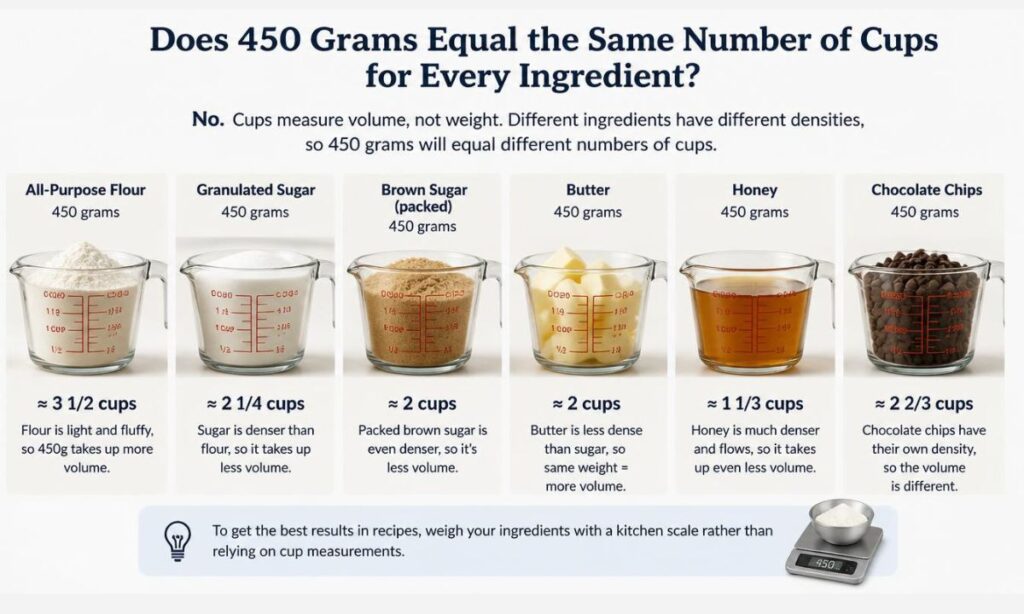
No. This is one of the most important things to understand about kitchen measurements.
A gram is a unit of mass, while a cup is a unit of volume. Mass tells you how much matter an ingredient contains; volume tells you how much space it occupies.
The relationship between the two is influenced by density, which describes the amount of mass in a particular volume.
Water has a density close to 1 gram per milliliter under ordinary kitchen conditions. That makes water conversions relatively simple. Flour, sugar, cocoa powder, and other dry ingredients contain air spaces between particles, so the amount that fits into a cup varies.
Three things can affect your result:
- Ingredient density: Honey is denser than flour, so the same weight occupies less space.
- Packing method: Pressing brown sugar into a cup increases the amount that fits inside.
- Ingredient condition: Humidity, particle size, and the way flour is scooped can influence its measured weight.
This explains why a universal 450g to cups converter needs an ingredient selection to produce a useful answer.
If your goal is accurate baking, measuring by weight is usually more reliable than measuring by volume. If your recipe only provides cups, however, a suitable conversion chart makes the process much easier.
450 Grams to Cups for Water, Flour, and Sugar
Let’s look more closely at three ingredients that appear in countless everyday recipes. Each has different measurement characteristics, so it’s helpful to understand how its conversion works.
450 Grams of Water to Cups
Water is one of the easiest ingredients to convert because its density is close to 1 gram per milliliter.
Therefore, 450 grams of water is approximately 450 mL.
Using a 250 mL metric cup:
450 ÷ 250 = 1.8 cups
Using a US customary cup of approximately 236.6 mL:
450 ÷ 236.6 ≈ 1.90 cups
So, 450 grams of water to cups equals 1.8 metric cups or approximately 1.9 US cups.
This conversion is useful when preparing soups, sauces, dough, drinks, and other recipes that call for water. For everyday cooking, these rounded figures are generally practical, though more precise recipes may require a scale or graduated liquid measuring jug.
450 Grams of Flour to Cups
Flour is trickier because it contains tiny air pockets. Scooping flour directly from a bag can compress it, causing more flour to fit into the same measuring cup.
If you use an estimate of 125 grams per 250 mL metric cup, the calculation is:
450 ÷ 125 = 3.6 cups
That means 450 grams of all-purpose flour is approximately 3.6 metric cups using this particular reference weight.
Different conversion charts may use a lower or higher weight per cup, so the result can vary. Bread flour, cake flour, and whole-wheat flour may also differ.
For the most consistent result, place a mixing bowl on a digital kitchen scale, reset the display to zero, and add flour until the scale reads 450 grams.
If you must use cups, fluff the flour gently, spoon it into the measuring cup, and level the top with a straight edge. Avoid packing it down unless the recipe specifically instructs you to do so.
450 Grams of Sugar to Cups
Sugar is usually easier to measure than flour because granulated sugar particles settle more consistently. However, the type of sugar still matters.
For granulated sugar, a practical estimate is 200 grams per metric cup.
450 ÷ 200 = 2.25 cups
Therefore, 450 grams of granulated sugar is approximately 2¼ metric cups.
Brown sugar is often measured differently because recipes commonly call for it to be packed into the cup. If one metric cup of packed brown sugar weighs around 220 grams, 450 grams works out to approximately 2.05 cups.
Caster sugar, raw sugar, and powdered sugar can have different cup weights due to their particle size and packing characteristics.
When a recipe specifies a particular sugar type, use the conversion for that type rather than substituting a generic sugar measurement. Small differences can affect sweetness, moisture, and the texture of baked goods.
Other Common Ingredient Conversions for 450 Grams
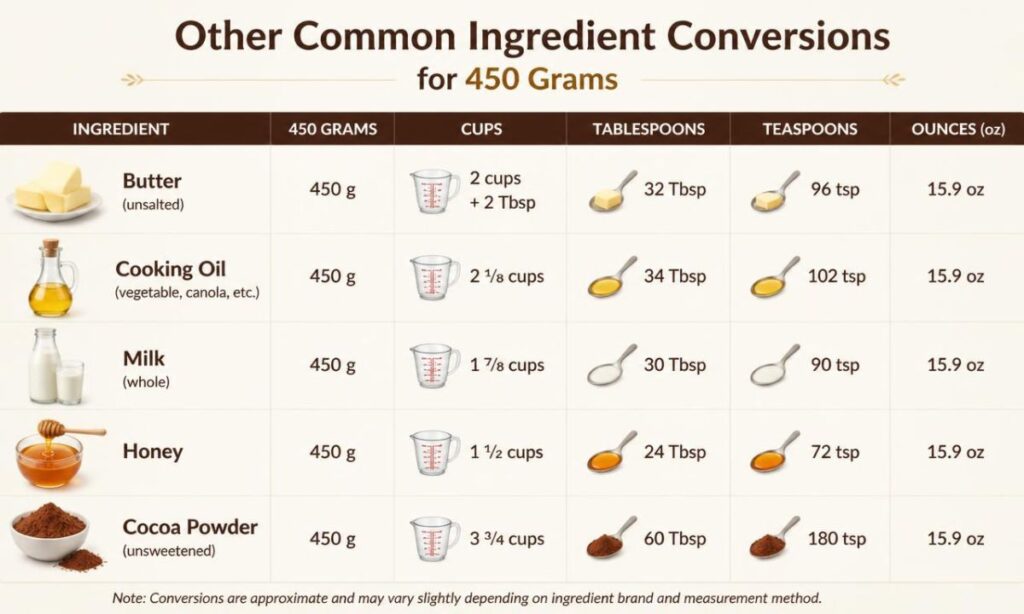
Beyond water, flour, and sugar, you may need to convert butter, oil, milk, honey, or cocoa powder. These examples show why ingredient-specific measurements are so useful.
Butter
Using an approximate weight of 227 grams per metric cup, 450 grams of butter equals about 1.98 cups, or almost two metric cups.
Butter is often easier to measure accurately when cold and firm. If the package provides gram markings, you can cut off the required amount without needing to fill a measuring cup.
Cooking oil
If one metric cup of oil weighs approximately 230 grams, 450 grams is about 1.96 metric cups.
Oil is a liquid, but its density differs from water. That means 450 grams of oil does not occupy exactly the same volume as 450 grams of water.
Milk
Milk is slightly denser than water. Using approximately 258 grams per metric cup, 450 grams works out to around 1.74 cups.
For everyday recipes, measuring milk in milliliters with a liquid measuring jug may be more convenient.
Honey
Honey is relatively dense. Using an estimated 350 grams per metric cup, 450 grams equals approximately 1.29 cups.
Because honey is sticky, lightly coating the measuring cup with a suitable thin layer of oil can make it easier to pour out. Alternatively, weigh the honey directly into the mixing bowl to avoid leaving a lot behind in the measuring container.
Cocoa powder
Cocoa powder is light and can be easily compressed. At an estimated 100 grams per metric cup, 450 grams would equal about 4.5 cups.
This is only an approximate example. Cocoa powder brands and measurement techniques vary, and such a large quantity is best weighed rather than measured by volume.
US Cups vs. Metric Cups
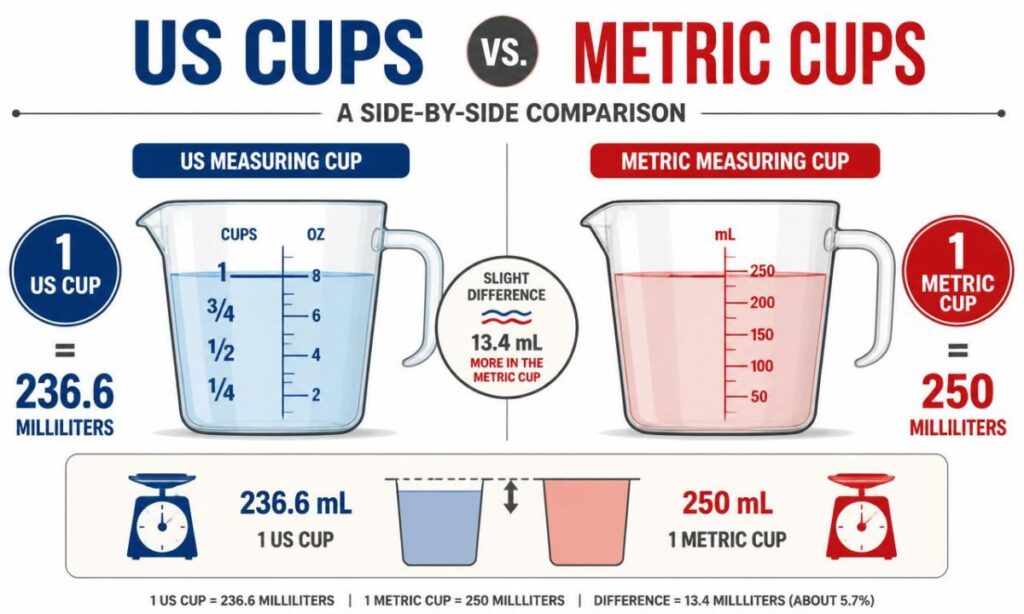
Cup measurements are not identical everywhere. If you regularly follow recipes from different countries, understanding the differences can prevent unnecessary confusion.
| Cup type | Approximate capacity |
|---|---|
| Metric cup | 250 mL |
| US customary cup | 236.6 mL |
| UK imperial cup | Approximately 284 mL |
The UK imperial cup is a historical measurement and is less common in modern British recipes. Many current UK recipes use grams and milliliters instead.
These differences matter because a cup is a volume measurement, not a fixed weight. One US cup of water contains approximately 236.6 grams, while one metric cup of water contains approximately 250 grams.
If a recipe comes from another country, check the measurement convention before converting ingredients.
Also, do not confuse cups with fluid ounces. Fluid ounces measure volume, while ordinary ounces can refer to weight. Although the names sound similar, they are not interchangeable in every situation.
Using a Grams to Cups Converter
A grams to cups converter is useful when you’re preparing a recipe and want a quick answer without performing repeated calculations.
Most conversion tools follow the same basic process:
- Enter the amount you want to convert, such as 450 grams.
- Select the ingredient, such as water, flour, or sugar.
- Choose the appropriate cup measurement if the calculator offers regional options.
- Review the result and use it as an estimate when the ingredient’s density can vary.
An ingredient-aware 450 grams to cups calculator is more useful than a general mass-to-volume calculator because it accounts for differences between substances.
For example, a calculator that assumes water density may return approximately 1.8 metric cups for 450 grams. If you use the same assumption for flour, the result will be misleading.
Remember that digital tools are only as accurate as the conversion factors they use. If you’re following a tested baking recipe, the ingredient weights specified by the original recipe should take priority over a rough online estimate.
Why Grams Are More Accurate Than Cups
Cups are convenient, especially when preparing simple meals. But when precision matters, grams offer several advantages.
First, a kitchen scale measures ingredients directly by mass. You don’t have to worry about whether flour is loosely packed, whether sugar has settled, or whether the top of the cup is level.
Second, weight measurements make recipes easier to repeat. If you bake the same bread every weekend, using exactly 450 grams of flour is likely to produce more consistent results than filling a cup several times and hoping each scoop is identical.
Third, grams make recipe scaling straightforward. If a recipe calls for 900 grams of flour and you want half the quantity, you simply measure 450 grams.
Cups still have their place. They are convenient for quick cooking, measuring liquids, and following recipes written around volume. The best approach is to use the measurement system that suits your recipe while understanding its limitations.
For delicate cakes, pastries, bread, and other recipes where ingredient ratios matter, a digital scale is a worthwhile addition to the kitchen.
Common Mistakes When Converting Grams to Cups
Even experienced home cooks can make small measurement mistakes. Fortunately, most are easy to avoid.
Assuming every ingredient weighs the same per cup. A cup is a fixed volume, but the mass inside it changes with the ingredient. Always check the relevant conversion factor.
Using the wrong cup standard. A metric cup and a US cup have different capacities. Check which system your recipe uses before converting.
Packing ingredients unintentionally. Pressing flour or cocoa powder into a measuring cup changes how much fits inside. Follow the method recommended by the recipe.
Confusing grams with milliliters. Grams measure mass, whereas milliliters measure volume. They are approximately equal numerically for water under ordinary conditions, but that relationship does not apply to every ingredient.
Relying on excessive decimal precision. If your ingredient density is only an estimate, reporting a result to several decimal places creates a false impression of accuracy. A practical rounded measurement is often more useful.
Ignoring the recipe’s instructions. Some recipes specify sifted flour, packed brown sugar, softened butter, or another preparation method. Those details affect how ingredients should be measured.
Avoiding these mistakes will help you achieve more predictable results without turning a simple recipe into a complicated calculation.
Explore More Blog : How to Calculate Cubic Yards
Frequently Asked Questions
How many cups are in 450 grams?
It depends on the ingredient. For water, 450 grams equals 1.8 metric cups or approximately 1.9 US cups. Flour, sugar, butter, and other ingredients have different gram-to-cup conversion factors.
Is 450 grams equal to 1.8 cups?
Yes, approximately, when measuring water with a 250 mL metric cup. It is not a universal conversion for other ingredients.
How many milliliters are in 450 grams?
There is no single milliliter value for 450 grams of every substance. For water, 450 grams is approximately 450 mL. For oil, flour, honey, and other ingredients, the volume differs because their densities differ.
Can I convert 450 grams to cups without a scale?
Yes. Use an ingredient-specific conversion chart or a reliable online calculator. However, the result may be less precise than weighing the ingredient, especially when measuring flour or other dry ingredients.
Why does flour have a different conversion from water?
Flour contains air spaces between its particles and has a lower bulk density than water. Consequently, a cup of flour usually weighs much less than a cup of water.
Are 450 grams and 450 milliliters the same?
Not generally. Grams measure mass, while milliliters measure volume. The two values are approximately equivalent for water under ordinary conditions, but not for every ingredient.
How many US cups are in 450 grams of water?
Using a US customary cup of approximately 236.6 mL, 450 grams of water equals about 1.90 US cups.
How do I measure 450 grams accurately for baking?
Place a bowl on a digital kitchen scale, reset the scale to zero, and add your ingredient until the display reads 450 grams. This method avoids many of the variations associated with measuring cups.
Conclusion
Converting 450 grams to cups is simple once you know which ingredient you’re measuring. For water, the answer is approximately 1.8 metric cups or 1.9 US cups. For flour, sugar, butter, honey, and other ingredients, the result changes according to density and measuring technique.
The most important lesson is to avoid treating grams and cups as interchangeable units. One measures mass, and the other measures volume. A reliable conversion chart, a suitable grams to cups calculator, or a digital kitchen scale can help you get the right quantity for your recipe.
Whether you’re preparing a family dinner, baking a birthday cake, or experimenting with a new dessert, accurate measurements can make the process smoother and the results more consistent.
And the next time a recipe calls for 450 grams, you’ll know exactly where to begin: identify the ingredient, choose the right conversion factor, and measure with confidence.
Is this conversation helpful so far?