
Have you ever needed to know what time it will be a day and a half from now? Maybe you’re planning a trip, waiting for an important delivery, preparing for a deadline, or simply curious about the future date and time. Whatever the reason, calculating 36 hours from now is easier than it might first seem.
Thirty-six hours may sound like a long stretch of time, but it equals just 1 day and 12 hours, or 1.5 days. The only tricky part is determining which date and clock time you’ll reach after adding those hours to the current time. Depending on when you start, the answer may fall tomorrow or the following calendar day.
A Time From Now Calculator makes this process simple by adding the specified number of hours, minutes, and seconds to the current time and displaying the resulting date and time. You can also work it out manually using a straightforward calculation.
In this guide, you’ll learn how to calculate 36 hours ahead, understand the difference between elapsed time and calendar days, use an online calculator, and apply this calculation to everyday situations.
What Is 36 Hours From Now?

36 hours from now means the exact moment that occurs 36 hours after the current time. Since a full day contains 24 hours, another 12 hours must be added to complete the calculation.
The basic formula is:
Future time = Current time + 36 hours
Because 36 hours equals 24 hours plus 12 hours, you can first move forward one full day and then advance the clock by another 12 hours.
For example, suppose the current time is 8:00 AM on October 18, 2026.
- Add 24 hours: 8:00 AM on October 19, 2026.
- Add another 12 hours: 8:00 PM on October 19, 2026.
Therefore, 36 hours from 8:00 AM on October 18 is 8:00 PM on October 19, 2026.
The result changes with the starting time. If you begin at 8:00 PM on October 18, adding 36 hours gives you 8:00 AM on October 20.
That’s why knowing the current time is just as important as knowing the number of hours you want to add.
How to Calculate 36 Hours From Now
You don’t necessarily need a calculator to determine a future time. A simple addition method works well, provided you keep track of the date and whether the clock moves from AM to PM or PM to AM.
Here’s how to calculate it step by step.
Step 1: Identify the Current Date and Time
Start by checking your local clock. Write down the exact time, including whether it’s AM or PM, and note the current date.
For example:
- Current date: October 18, 2026
- Current time: 10:00 AM
- Hours to add: 36
Using the correct starting point is important because even a small difference in the initial time changes the final result.
Step 2: Add the First 24 Hours
Adding 24 hours takes you to the same clock time on the following calendar day.
If it’s 10:00 AM on October 18, another 24 hours brings you to 10:00 AM on October 19.
This is one complete 24-hour period, representing one full day of elapsed time.
Step 3: Add the Remaining 12 Hours
Now add the remaining 12 hours to the new time.
Starting from 10:00 AM on October 19:
- Six hours later is 4:00 PM.
- Another six hours brings you to 10:00 PM.
Your final answer is 10:00 PM on October 19, 2026.
Step 4: Confirm the Final Date and Time
Double-check that you’ve accounted for all 36 hours. Remember that adding 12 hours switches AM to PM or PM to AM, although crossing midnight can also change the calendar date.
For longer calculations, especially those involving minutes and seconds, an online Time From Now Calculator can help avoid arithmetic mistakes.
How Many Days Is 36 Hours?
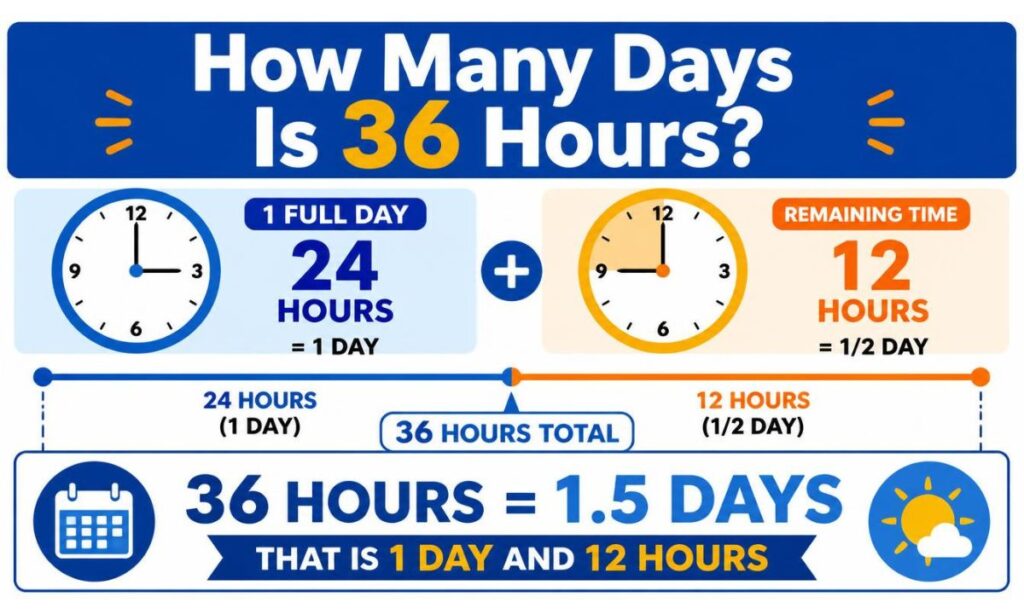
Thirty-six hours is equivalent to 1.5 days, which means one full day and half of another day.
The conversion is straightforward because one standard day contains 24 hours.
36÷24=1.5 days
You can also express the duration as:
- 36 hours
- 2,160 minutes
- 129,600 seconds
- 1 day and 12 hours
- 1.5 days
To convert hours into minutes, multiply the number of hours by 60:
36×60=2,160 minutes
To convert hours into seconds, multiply by 3,600:
36×3,600=129,600 seconds
These conversions are useful when working with schedules, timers, work shifts, cooking durations, and other activities that depend on precise time intervals.
It’s also worth remembering that 36 hours is not always the same as two calendar dates ahead. It represents a fixed elapsed duration, while calendar dates depend on the starting time.
How to Use a 36 Hours From Now Calculator
An online 36 hours from now calculator is a convenient way to find the future date and time without manually adding hours. Depending on the tool, you may be able to enter hours, minutes, and seconds to calculate a more specific result.
Most time calculators follow a similar process.
Enter the Number of Hours
Find the hours input field and enter 36. If the calculator includes separate fields for minutes and seconds, leave them at zero unless you want to add extra time.
For example, entering 36 hours, 30 minutes, and 0 seconds calculates a future moment 36 hours and 30 minutes from the starting time.
Check the Starting Time
Some calculators automatically use the current date and time. Others allow you to enter a custom starting point.
If the calculator uses your current time automatically, make sure its displayed time zone matches your intended location. This is especially useful when planning international meetings or travel.
Click the Calculate Button
Press the Calculate button to generate the result. The calculation output may show the future time, future date, day of the week, and total duration.
Some tools also include a Clear button that resets the input fields so you can start another calculation.
Read the Result
Review the final date and time carefully. If the calculator uses a 12-hour clock, the answer should identify AM or PM. A 24-hour clock may display the same result as a value such as 20:00 instead of 8:00 PM.
A reliable time calculation tool can be especially helpful when you’re working with several different time intervals or planning events in advance.
36 Hours From Now: Date and Time Examples
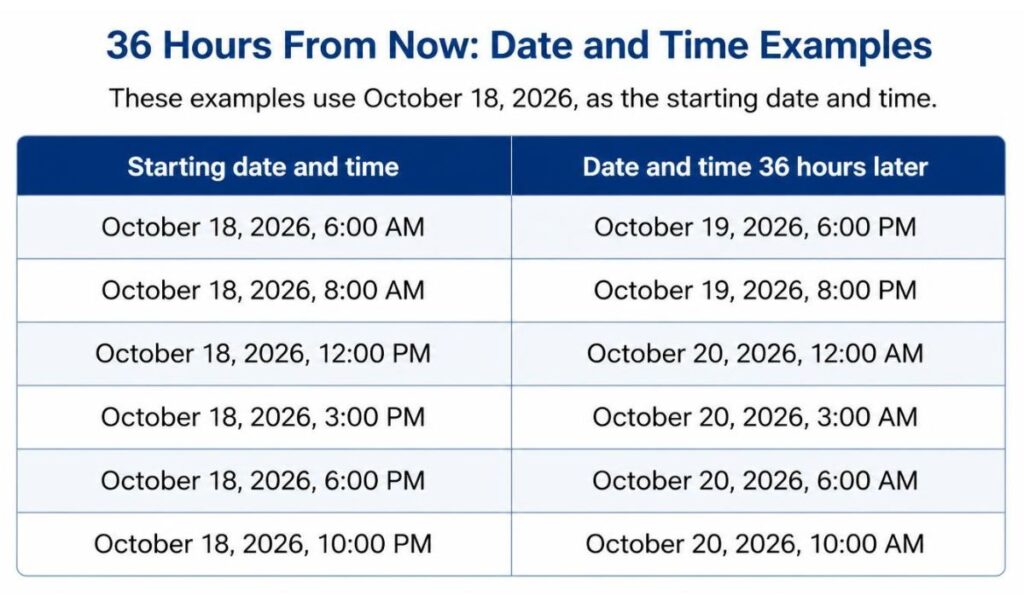
The following examples show how adding 36 hours changes the clock time and calendar date.
These examples use October 18, 2026, as the starting date and assume the times shown are local times. They illustrate the calculation rather than a live reading of your clock.
| Starting date and time | Date and time 36 hours later |
|---|---|
| October 18, 2026, 6:00 AM | October 19, 2026, 6:00 PM |
| October 18, 2026, 8:00 AM | October 19, 2026, 8:00 PM |
| October 18, 2026, 12:00 PM | October 20, 2026, 12:00 AM |
| October 18, 2026, 3:00 PM | October 20, 2026, 3:00 AM |
| October 18, 2026, 6:00 PM | October 20, 2026, 6:00 AM |
| October 18, 2026, 10:00 PM | October 20, 2026, 10:00 AM |
Notice how the date changes depending on the starting time. When you start before noon, the result may occur the following evening. When you start later in the day, the additional 12 hours can push the result into the second calendar date after the starting date.
This is why a date and time calculator is useful: it accounts for both the clock and the calendar instead of simply reporting a number of hours.
Practical Uses of a 36-Hour Time Calculation
Calculating a future time isn’t just a mathematical exercise. It can help you organize daily responsibilities, plan travel, manage appointments, and keep track of deadlines.
Travel and Journey Planning
Suppose you’re preparing for a journey that requires 36 hours of travel, including planned breaks. Knowing the estimated arrival time can help you organize accommodation, transport connections, and arrangements with people waiting for you.
However, real travel durations may change because of delays, weather, or unexpected stops. Treat the calculated arrival time as a planning estimate when the journey itself is uncertain.
Office Schedules and Work Deadlines
Imagine your manager gives you 36 hours to complete a task. If you receive the assignment at 9:00 AM on Monday, your deadline falls at 9:00 PM on Tuesday, assuming the deadline is measured as a continuous 36-hour period.
This distinction matters because a deadline described as “within 36 hours” is not necessarily the same as “by the end of the next working day.” Always check the precise instructions.
Cooking and Food Preparation
Some recipes require long preparation periods, including marinating, resting, fermenting, or chilling. If a recipe calls for a 36-hour process, calculating the finishing time can help you plan meals without constantly checking the clock.
For example, beginning a preparation process at 7:00 PM on Friday means 36 hours later will be 7:00 AM on Sunday.
For food safety, follow the recipe’s temperature and storage instructions rather than relying on elapsed time alone.
Appointment Planning
You may need to schedule a follow-up call, arrange a pickup, or plan an appointment 36 hours after an initial event.
Adding the hours precisely helps you avoid confusion, particularly when the interval crosses midnight or extends into another day.
Personal Tasks and Event Preparation
A 36-hour window can also help with short-term planning. Perhaps you’re preparing for a family gathering, finishing a home project, organizing a trip, or setting aside time to complete an assignment.
Breaking the period into manageable blocks can make the deadline feel less overwhelming. You might allocate the first 24 hours to the main task and the remaining 12 hours to final checks, preparation, or rest.
Understanding AM, PM, and Midnight When Adding 36 Hours
One of the most common sources of confusion when calculating future times is the difference between AM and PM.
The 12-hour clock repeats its displayed hour values twice each day. For instance, 8:00 AM and 8:00 PM are 12 hours apart, even though both show the number eight.
Adding 12 hours therefore changes AM to PM or PM to AM.
Midnight introduces another detail because it marks the beginning of a new calendar day. For example, if you add 36 hours to noon on October 18, 2026, the result is midnight at the beginning of October 20.
In a 24-hour clock, this is written as 00:00 on October 20. In a 12-hour clock, it is 12:00 AM on October 20.
Here are a few useful conversions:
| 12-hour clock | 24-hour clock |
|---|---|
| 6:00 AM | 06:00 |
| 12:00 PM (noon) | 12:00 |
| 6:00 PM | 18:00 |
| 12:00 AM (midnight) | 00:00 |
When checking a calculator result, make sure you understand which clock format it uses. This small detail can prevent mistakes when setting alarms, arranging transportation, or meeting a deadline.
Does the Time Zone Affect 36 Hours From Now?
Yes, the time zone can matter when you need an exact future time, particularly for travel, remote work, or international scheduling.
For ordinary local calculations, adding 36 hours to your current clock time is usually straightforward. However, regions that observe daylight saving time can change their clocks during the interval. As a result, 36 elapsed hours may not always produce a local clock time exactly 36 displayed hours later.
For example, when clocks move forward or backward, the difference between elapsed time and local clock readings can become more complicated.
If you’re scheduling a meeting across different countries, specify the time zone and date instead of relying on a clock time alone. A dependable future date calculator should use the appropriate time zone when that information is relevant.
For most everyday calculations, simply use your current local date and time. For travel, international deadlines, and daylight-saving transitions, verify the final result with a time-zone-aware tool.
Explore More Blog : 450 Grams to Cups
Frequently Asked Questions
What Time Will It Be in 36 Hours?
The answer depends on your current time. Add 24 hours to reach the same time tomorrow, then add another 12 hours. For example, if it’s 9:00 AM now, 36 hours later will be 9:00 PM on the following calendar day.
What Date Will It Be 36 Hours From Now?
The date depends on the starting time. If you begin early in the day, the result may fall on the next calendar date. If you begin later, the additional 12 hours may move the result to the calendar date after that.
Is 36 Hours One or Two Days?
Thirty-six hours is one and a half days. It is longer than one full day but shorter than two full days, which equal 48 hours.
How Do I Add 36 Hours to the Current Time?
Add 24 hours first, then add 12 more hours. Keep track of any midnight crossings and update the calendar date whenever necessary. An online time from now calculator can perform this calculation automatically.
Does 36 Hours From Now Include Tomorrow?
Yes. A 36-hour period will normally include at least part of the next calendar day. Depending on the starting time, the final moment may occur tomorrow or the following day.
How Many Minutes Are in 36 Hours?
There are 2,160 minutes in 36 hours. Multiply 36 by 60 because each hour contains 60 minutes.
How Many Seconds Are in 36 Hours?
There are 129,600 seconds in 36 hours. Multiply 36 by 3,600, the number of seconds in one standard hour.
What Is 48 Hours From Now?
Forty-eight hours equals two full days. Adding 48 hours to a starting time generally gives the same clock time two calendar days later, provided no time-zone or daylight-saving adjustment affects the local clock.
Can I Calculate 36 Hours From a Specific Date?
Yes. Start with your chosen date and time, then add 36 hours. This is useful when planning a future appointment or working backward from a known starting point. A date and time calculator that accepts custom inputs can make the process easier.
Conclusion
Knowing how to calculate 36 hours from now can make everyday planning much easier. Whether you’re organizing a trip, tracking a deadline, preparing a meal, or scheduling an appointment, the calculation follows one simple rule: add 24 hours and then another 12.
Remember that 36 hours equals 1 day and 12 hours, or 1.5 days. The exact future date depends on your starting time, so always check the clock, calendar date, and AM or PM designation.
For a quick answer, use a 36 hours from now calculator. For a manual calculation, split the duration into one full day and half a day, then confirm the final date and time.
A little attention to the details can save you from missed appointments and confusing deadlines. Once you understand the process, calculating future times becomes a simple and useful part of managing your day.