Calculating cubic yards might sound like one of those construction tasks that requires a lot of complicated math, but it’s actually much easier than most people expect. Whether you’re preparing a garden bed, ordering mulch for your backyard, pouring a concrete driveway, or filling a low area with soil, knowing how to calculate cubic yards helps you order the right amount of material without wasting money.
The trick is to understand three simple measurements: length, width, and depth. Once you have these numbers, you can use a basic cubic yard formula to estimate the volume of material your project needs. A free cubic yard calculator can make the process even faster, especially when you’re working with different dimensions or materials.
In this guide, you’ll learn how to calculate cubic yards step by step, convert cubic feet into cubic yards, use an online yardage calculator, estimate material costs, and handle different shapes. We’ll also cover practical examples for concrete, gravel, mulch, topsoil, sand, and other bulk materials, so you can apply the calculations to real projects without guessing.
What Is a Cubic Yard?
A cubic yard is a unit of volume used to measure three-dimensional space. It describes how much space a material occupies rather than how much surface area it covers.
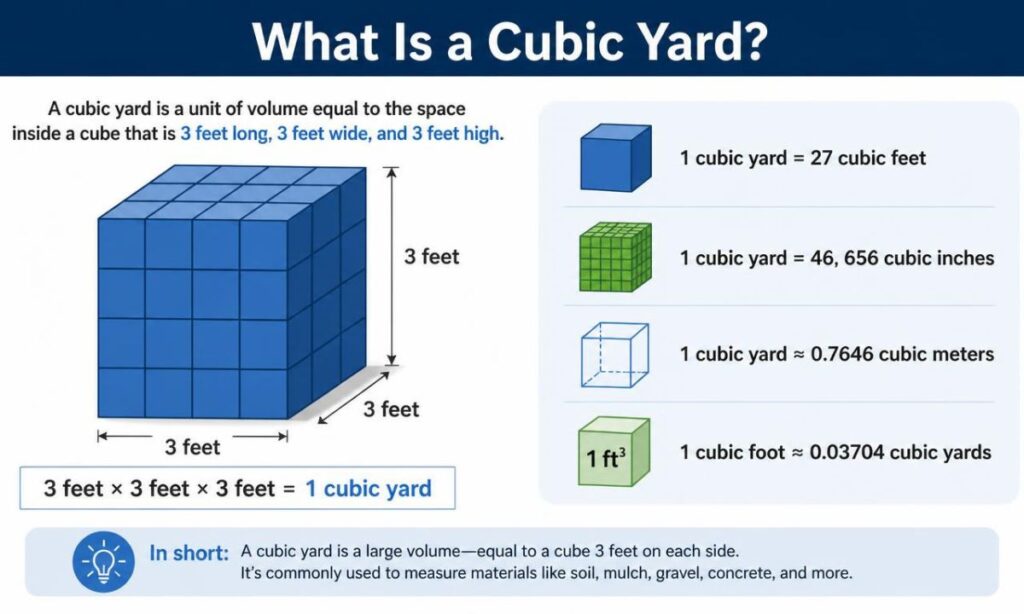
One cubic yard is equal to a cube measuring one yard long, one yard wide, and one yard high. Since one yard equals three feet, the dimensions of a cubic yard are 3 feet × 3 feet × 3 feet.
That means:
- 1 cubic yard = 27 cubic feet
- 1 cubic yard = 46,656 cubic inches
- 1 cubic yard ≈ 0.7646 cubic meters
- 1 cubic foot ≈ 0.03704 cubic yards
The unit is commonly used in construction, landscaping, excavation, and home improvement because materials such as soil, gravel, sand, and concrete are frequently sold by the cubic yard.
For example, if a landscaping supplier tells you that one cubic yard of mulch costs $45, you know the price applies to a volume of material rather than a particular length of garden or driveway.
Understanding cubic yard dimensions is especially helpful when comparing the amount of material you need with the quantity offered by a supplier.
How to Calculate Cubic Yards Using the Basic Formula
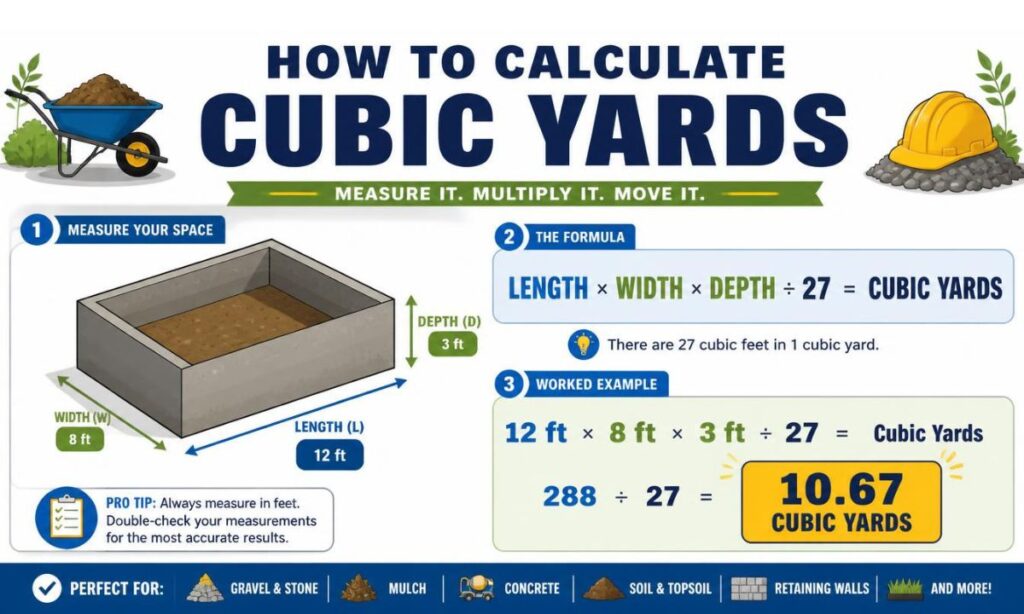
The easiest way to calculate cubic yards is to multiply the length, width, and depth of the space, then divide the result by 27. This method works for rectangular areas when all three measurements are expressed in feet.
The formula is:
Cubic Yards = (Length × Width × Depth) ÷ 27
In mathematical notation:
[
\text{Cubic Yards}=\frac{L\times W\times D}{27}
]
Here, L represents length, W represents width, and D represents depth or height.
Let’s look at a simple example.
Imagine you want to fill a rectangular garden bed that measures 12 feet long, 6 feet wide, and 1 foot deep.
First, multiply the dimensions:
12 × 6 × 1 = 72 cubic feet
Next, divide the volume by 27:
72 ÷ 27 = 2.67 cubic yards
You would need approximately 2.67 cubic yards of material to fill the space to the specified depth, assuming the dimensions are accurate and the material settles as expected.
If the supplier only sells whole cubic yards, you may need to order 3 cubic yards. However, check whether partial-yard orders are available before making your purchase.
The calculation itself is straightforward. The important part is measuring the area correctly and keeping all dimensions in the same unit.
How to Use a Free Cubic Yard Calculator
An online cubic yard calculator can save time when you don’t want to perform every calculation manually. It is especially convenient for larger construction projects or when you need to estimate several materials.
Most cubic yard calculators follow a similar process.
- Choose the shape: Select the shape that matches your project, such as a box, cube, cylinder, cone, or another available option.
- Enter the dimensions: Add the required measurements, including length, width, depth, height, or radius, depending on the shape.
- Select the measurement unit: Use feet, inches, yards, or another supported unit. Check that the selected unit matches your entries.
- Add the material price if available: Enter the price per cubic yard to estimate the material cost.
- Click Calculate: The tool processes your measurements and displays the volume in cubic yards.
- Review the conversion results: Some tools also show cubic feet, cubic meters, or other volume units.
- Use Clear when needed: Reset the calculator before entering a different project’s dimensions.
A calculator may include a shape dropdown with options such as Box, Cube, Cylinder, Hollow Cuboid, Rectangular Tube, Hollow Cylinder, Hemisphere, Cone, Pyramid, and Other Shape.
These options are useful because not every project is a simple rectangular space. A concrete column, for instance, needs a different volume formula than a rectangular patio.
A free online cubic yard calculator is a helpful estimation tool, but it still depends on accurate measurements. If you enter the wrong depth or accidentally mix inches with feet, the result will be incorrect even if the calculator performs the arithmetic perfectly.
How to Calculate Cubic Yards for Different Shapes
The standard length × width × depth formula works for rectangular spaces. Other shapes require their own volume formulas before the result can be converted into cubic yards.
Box or Rectangular Prism
A box-shaped area is one of the most common forms encountered in landscaping and construction.
Use:
Volume = Length × Width × Height
Suppose a rectangular excavation is 15 feet long, 8 feet wide, and 2 feet deep.
15 × 8 × 2 = 240 cubic feet
240 ÷ 27 = 8.89 cubic yards
You would need approximately 8.89 cubic yards to fill the measured space before accounting for settling, compaction, or other project-specific requirements.
Cube
A cube has three equal dimensions, so its volume formula is simpler.
Volume = Side × Side × Side
If each side measures 3 feet:
3 × 3 × 3 = 27 cubic feet
27 ÷ 27 = 1 cubic yard
This is exactly the volume of one cubic yard.
Cylinder
Cylindrical spaces appear in round concrete footings, circular holes, and some landscaping features.
Use the formula:
Volume = π × Radius² × Height
Suppose a cylindrical footing has a radius of 1.5 feet and a height of 2 feet.
Volume = π × 1.5² × 2
Volume ≈ 14.14 cubic feet
14.14 ÷ 27 ≈ 0.52 cubic yards
The radius is half the diameter, so be sure not to enter the full width of the circle when the formula asks for the radius.
Cone
A cone-shaped space has a narrower top or bottom and is different from a cylinder.
Volume = (π × Radius² × Height) ÷ 3
For a cone with a radius of 3 feet and a height of 4 feet:
Volume = (π × 3² × 4) ÷ 3
Volume ≈ 37.70 cubic feet
37.70 ÷ 27 ≈ 1.40 cubic yards
Hemisphere
A hemisphere is half of a sphere. This shape can be relevant when estimating certain rounded cavities or features.
Volume = (2 × π × Radius³) ÷ 3
If the radius is 3 feet:
Volume = (2 × π × 3³) ÷ 3
Volume ≈ 56.55 cubic feet
56.55 ÷ 27 ≈ 2.09 cubic yards
Pyramid
For a pyramid with a rectangular or other measurable base, multiply the base area by the height and divide by three.
Volume = (Base Area × Height) ÷ 3
If the base area is 36 square feet and the height is 6 feet:
Volume = (36 × 6) ÷ 3
Volume = 72 cubic feet
72 ÷ 27 ≈ 2.67 cubic yards
Hollow Cuboid or Rectangular Tube
A hollow rectangular structure requires you to subtract the inner volume from the outer volume.
Material Volume = Outer Volume − Inner Volume
Calculate both rectangular volumes using their respective dimensions. Subtract the inner volume from the outer volume, then divide the remaining cubic feet by 27.
This method can estimate the amount of material in a hollow structure, provided the dimensions accurately describe the material’s boundaries.
Hollow Cylinder
A hollow cylinder, such as a cylindrical shell, requires both an outer radius and an inner radius.
Volume = π × Height × (Outer Radius² − Inner Radius²)
After calculating the volume in cubic feet, divide by 27 to obtain cubic yards.
For irregular shapes that do not fit these formulas, divide the area into smaller, measurable sections or use an appropriate cross-sectional area method. Estimating each section separately often produces a more reliable result than trying to force the entire space into one formula.
How to Convert Cubic Feet to Cubic Yards
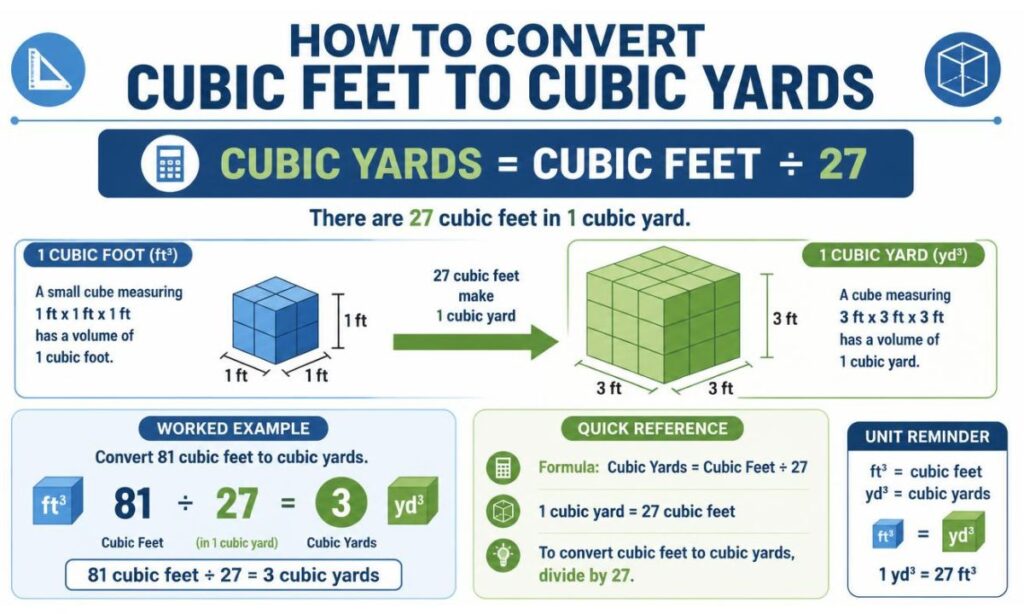
Converting cubic feet to cubic yards is an essential part of calculating material volume. Many people measure a project in feet but purchase the material in cubic yards, so the conversion connects the measurements to the supplier’s pricing.
The conversion formula is:
Cubic Yards = Cubic Feet ÷ 27
For example, a patio base has a volume of 135 cubic feet.
135 ÷ 27 = 5 cubic yards
Therefore, the patio base requires 5 cubic yards of material based on its calculated volume.
To convert cubic yards back into cubic feet, multiply by 27 instead.
Cubic Feet = Cubic Yards × 27
For instance:
4 cubic yards × 27 = 108 cubic feet
Here is a quick cubic yard conversion table:
| Cubic Feet | Cubic Yards |
|---|---|
| 27 | 1 |
| 54 | 2 |
| 81 | 3 |
| 108 | 4 |
| 135 | 5 |
| 270 | 10 |
| 540 | 20 |
Remember that volume conversions are different from length or area conversions. One yard equals three feet, but one cubic yard equals 27 cubic feet because the conversion applies to three dimensions.
How to Calculate Cubic Yards When Measurements Are in Inches
If your measurements are in inches, you can convert each dimension into feet before using the main formula.
Divide each measurement by 12.
For example, a small rectangular space measures 120 inches long, 72 inches wide, and 12 inches deep.
Convert the dimensions:
- Length: 120 ÷ 12 = 10 feet
- Width: 72 ÷ 12 = 6 feet
- Depth: 12 ÷ 12 = 1 foot
Calculate the volume:
10 × 6 × 1 = 60 cubic feet
Convert to cubic yards:
60 ÷ 27 ≈ 2.22 cubic yards
You can also calculate the volume directly in cubic inches and divide by 46,656, but converting to feet first is often easier to follow.
How to Calculate Cubic Yards for Concrete
Concrete projects require accurate volume estimates because ordering too little can delay the pour, while ordering too much may increase costs and create disposal problems.
For a rectangular concrete slab, use:
Concrete Cubic Yards = (Length × Width × Thickness) ÷ 27
All dimensions must be in feet.
Suppose you’re planning a concrete patio that measures 20 feet long, 12 feet wide, and 4 inches thick.
First, convert the thickness into feet:
4 ÷ 12 = 0.3333 feet
Next, calculate the volume:
20 × 12 × 0.3333 ≈ 80 cubic feet
Finally, convert cubic feet to cubic yards:
80 ÷ 27 ≈ 2.96 cubic yards
The theoretical volume is approximately 2.96 cubic yards.
For an actual concrete order, you may need a modest allowance for uneven ground, form variations, spillage, and other job conditions. The right allowance depends on the project, and structural work should follow the contractor’s or engineer’s specifications.
For a driveway, concrete foundation, or slab with different thicknesses, calculate each section separately and add the volumes together. A concrete cubic yard calculator can help simplify this process.
How to Calculate Cubic Yards of Gravel
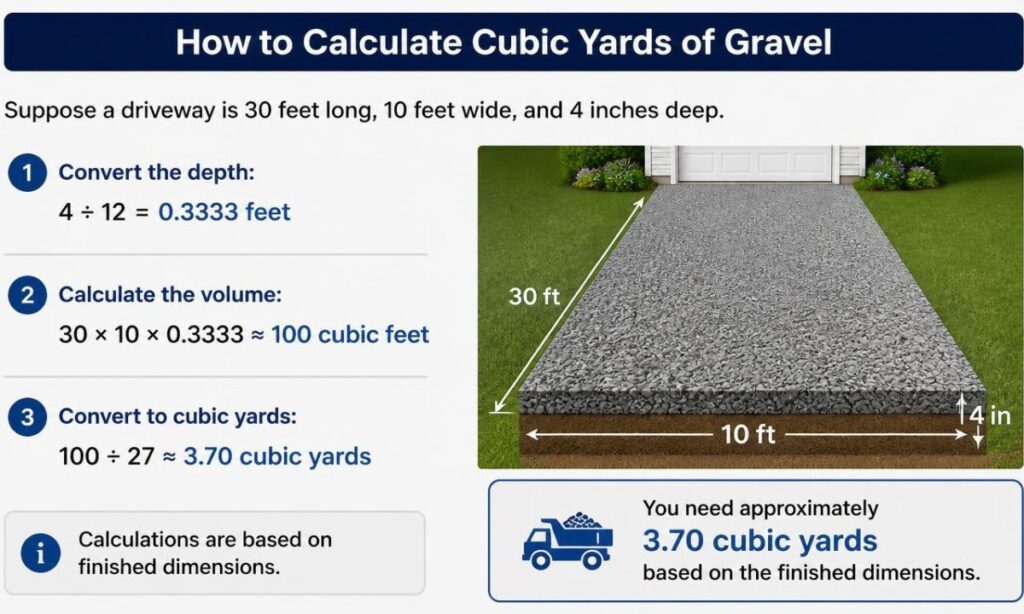
Gravel is commonly purchased for driveways, walkways, drainage systems, and foundation bases. The required amount depends on the area you want to cover and the planned depth of the gravel layer.
Suppose a driveway is 30 feet long, 10 feet wide, and 4 inches deep.
Convert the depth:
4 ÷ 12 = 0.3333 feet
Calculate the volume:
30 × 10 × 0.3333 ≈ 100 cubic feet
Convert to cubic yards:
100 ÷ 27 ≈ 3.70 cubic yards
You need approximately 3.70 cubic yards based on the finished dimensions.
However, gravel may settle or compact during installation. If the project requires a compacted base, ask the supplier or contractor whether the quantity should be adjusted for the material type and compaction requirements.
A gravel cubic yard calculator is useful for comparing different driveway sizes, especially when you are estimating both the material quantity and the delivery cost.
How to Calculate Cubic Yards of Mulch
Mulch helps protect soil, retain moisture, suppress weeds, and improve the appearance of garden beds. To calculate how much mulch you need, measure the garden bed’s length, width, and planned mulch depth.
Imagine a garden bed that is 18 feet long, 8 feet wide, and 3 inches deep.
Convert the depth:
3 ÷ 12 = 0.25 feet
Calculate the volume:
18 × 8 × 0.25 = 36 cubic feet
Convert the volume:
36 ÷ 27 = 1.33 cubic yards
You would need approximately 1.33 cubic yards of mulch to cover the area at the specified depth.
If the garden bed has an irregular outline, divide it into rectangular sections, calculate each section, and add the results together. For circular beds, use the appropriate circular area formula before multiplying by the depth.
A mulch cubic yard calculator can help you plan several garden beds without repeatedly doing the arithmetic from scratch.
How to Calculate Cubic Yards of Soil, Topsoil, and Sand
Soil, topsoil, fill dirt, and sand are often sold by volume. Their quantities can be estimated with the same rectangular formula, although their weight and behavior can differ significantly.
Consider a raised garden bed that measures 10 feet long, 4 feet wide, and 1.5 feet deep.
Multiply the dimensions:
10 × 4 × 1.5 = 60 cubic feet
Divide by 27:
60 ÷ 27 ≈ 2.22 cubic yards
The calculated volume is approximately 2.22 cubic yards.
This method works for estimating topsoil, compost, sand, fill dirt, and landscaping soil when the space is rectangular.
Still, remember that a cubic yard is a measure of volume, not weight. Different materials have different densities, and moisture content can change their weight considerably. If you need to know whether a truck can carry the load, check the supplier’s weight information as well as the volume.
For excavation projects, calculate the dimensions of the area being removed. If the ground is uneven, estimate each section separately. Loose excavated soil may also occupy more volume than the same soil did in its compacted state.
How Much Material Does One Cubic Yard Cover?
The coverage of one cubic yard depends on how thickly you spread the material. A cubic yard always contains 27 cubic feet, but the area it covers changes with the depth.
For a rectangular layer:
Area in Square Feet = Volume in Cubic Feet ÷ Depth in Feet
Since one cubic yard equals 27 cubic feet, the coverage formula is:
Coverage = 27 ÷ Depth in Feet
Here are some approximate coverage amounts for one cubic yard:
| Material Depth | Approximate Coverage |
|---|---|
| 1 inch | 324 sq ft |
| 2 inches | 162 sq ft |
| 3 inches | 108 sq ft |
| 4 inches | 81 sq ft |
| 6 inches | 54 sq ft |
| 12 inches | 27 sq ft |
These figures assume a level, rectangular layer with no allowance for uneven surfaces, settling, compaction, or waste.
For example, one cubic yard of mulch can cover approximately 108 square feet at a depth of 3 inches. If your garden bed measures 216 square feet, you would need about 2 cubic yards to achieve that depth under ideal conditions.
The same mathematical relationship applies to other bulk materials, but the recommended depth depends on the purpose of the material and the project specifications.
How to Estimate the Cost Per Cubic Yard
Once you know the volume, estimating the material cost is straightforward.
Use:
Material Cost = Cubic Yards Needed × Price per Cubic Yard
Suppose you need 4 cubic yards of gravel, and the supplier charges $48 per cubic yard.
4 × $48 = $192
The estimated material cost is $192 before delivery fees, taxes, minimum-order charges, or other expenses.
If the supplier charges a flat delivery fee of $60, the estimated total becomes:
$192 + $60 = $252
When comparing suppliers, check whether their quoted price includes delivery and whether the price changes for smaller orders.
For a more accurate budget, calculate each material separately. Concrete, sand, gravel, mulch, and topsoil can have very different prices even when the required volume is the same.
A cubic yard cost calculator can be particularly useful when comparing two material types or planning several stages of a landscaping project.
Common Mistakes to Avoid When Calculating Cubic Yards
Even a simple volume calculation can go wrong when measurements or assumptions are inconsistent. A few quick checks can prevent unnecessary expenses.
- Mixing measurement units: Do not multiply feet by inches without converting them first. Convert all dimensions to a common unit.
- Forgetting to divide by 27: Multiplying length, width, and depth in feet gives cubic feet, not cubic yards.
- Confusing square feet with cubic feet: Square feet measure area, while cubic feet measure volume. Depth is needed to turn area into volume.
- Using diameter instead of radius: Cylinder formulas generally require the radius, which is half the diameter.
- Ignoring uneven ground: Slopes and irregular spaces may require several smaller calculations rather than one rectangular estimate.
- Ordering only the exact theoretical amount: Some projects require extra material for compaction, settling, spillage, or variations in the surface.
- Assuming every cubic yard weighs the same: Material density varies. Check weight limits when ordering or transporting heavy loads.
- Rounding too early: Keep a few decimal places during the calculation and round the final quantity afterward.
It is also worth measuring twice before ordering. A small difference in depth across a large area can create a noticeable change in the total volume.
Explore More Blog : How Many Months Until October?
Frequently Asked Questions
What Is a Cubic Yard Calculator?
A cubic yard calculator helps you determine the volume of materials like gravel, sand, mulch, and soil needed for your project. Simply enter the length, width, and depth to get the result in cubic yards.
How Do You Calculate Gravel Yardage?
To calculate gravel yardage, multiply the length by the width and depth of the area, using the same unit of measurement. Divide the result in cubic feet by 27 to convert it into cubic yards.
What Is the Formula for Calculating Cubic Yards?
The formula for cubic yards is Length × Width × Depth ÷ 27 when all measurements are in feet. This calculation gives you the total volume needed for landscaping, construction, or other projects.
How Much Gravel Do You Need for Your Project?
The amount of gravel you need depends on the area’s dimensions and the desired depth of coverage. Measure the space carefully and use a cubic yard calculator to estimate the quantity and avoid ordering too much or too little.
Conclusion
Learning how to calculate cubic yards makes landscaping, construction, and home improvement projects easier to plan. Once you understand the relationship between length, width, depth, and volume, you can estimate the amount of concrete, gravel, mulch, topsoil, sand, or fill dirt your project requires.
For rectangular spaces, remember the central formula: multiply the length, width, and depth in feet, then divide by 27. For cylinders, cones, pyramids, and other shapes, calculate the volume using the appropriate formula before converting the result into cubic yards.
A free cubic yard calculator can simplify the process, particularly when working with multiple dimensions or estimating costs. Still, accurate measurements and sensible allowances for compaction, settling, and waste are what turn a quick calculation into a useful project estimate.
Before placing an order, double-check your measurements, confirm the material’s recommended depth, and ask the supplier about delivery charges and quantity requirements. A few extra minutes of preparation can save you from an expensive second delivery or a pile of unused material.
If you’ve used a cubic yard calculator for a driveway, garden bed, concrete slab, or another project, share your experience or calculation tips in the comments. Your practical advice may help someone else get their measurements right the first time.