A kitchen can feel like a tiny laboratory when a recipe asks for tbsp, while your kitchen scale is waiting in grams. You have the spoon in one hand, the recipe in the other, and suddenly the simple question appears: how many grams are in a tablespoon? It sounds like one of those measurements that should have one fixed answer, but there’s a little more to it than that.
The important thing to remember is that a tablespoon is a volume measurement, while a gram is a mass measurement. So tbsp in grams does not have one universal number for every ingredient. Water, flour, honey, butter, sugar and spices can all occupy the same spoon but have different weights. Thats why ingredient density matters so much.
Whether you’re following a recipe, scaling up a batch, converting an old family recipe, or simply trying to understand a confusing measurement, this guide explains tablespoons to grams, tbsp to grams, and grams to tablespoons in a practical way.
What Does Tbsp Mean?
Tbsp is a common abbreviation for tablespoon. In cooking, a tablespoon is used to measure both liquids and dry ingredients, although the actual weight changes according to the ingredient being measured.
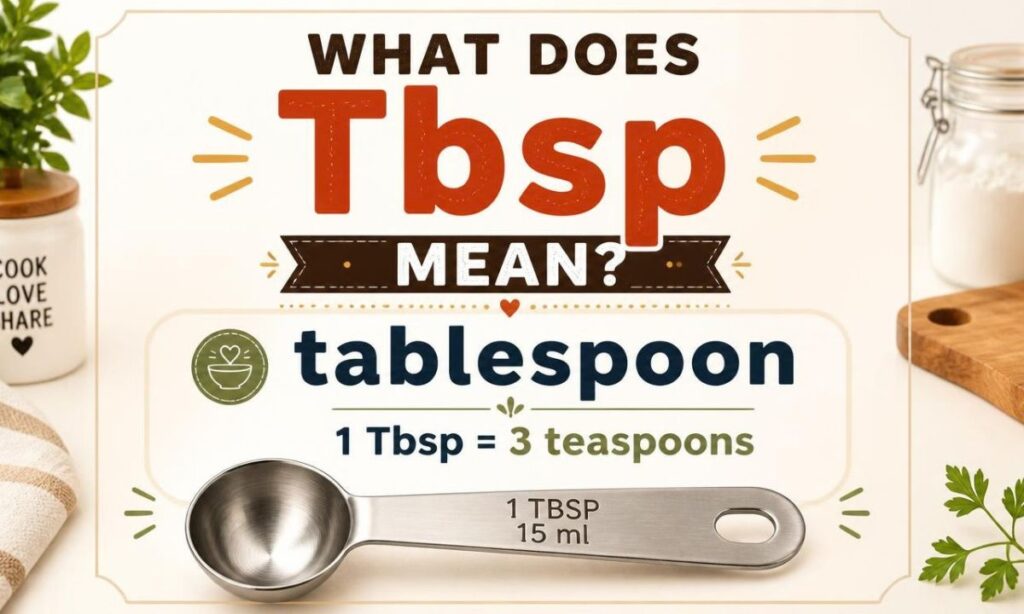
A standard US tablespoon is approximately 15 milliliters, or 15 ml, which is also about 0.015 liters and 15 cubic centimeters. In many recipes, 1 tablespoon is also equal to 3 teaspoons, written as 3 tsp or sometimes 3 teaspoons.
So, in simple terms:
- 1 tablespoon = 15 ml
- 1 tbsp = 15 ml
- 1 tbsp = 3 teaspoons
- 1 tbsp = 0.015 liters
- 1 tbsp ≈ 15 cubic centimeters
But 15 ml does not automatically mean 15 grams. Thats where the difference between volume and mass comes in.
Tbsp in Grams: Why the Answer Changes
The answer to tbsp in grams depends mainly on the ingredient’s density. A tablespoon of water weighs about 15 grams because water has a density close to 1 gram per milliliter. A tablespoon of flour weighs considerably less because flour is much lighter and contains air between its particles.
This is why different ingredients have different weights even when they occupy exactly the same spoon volume.
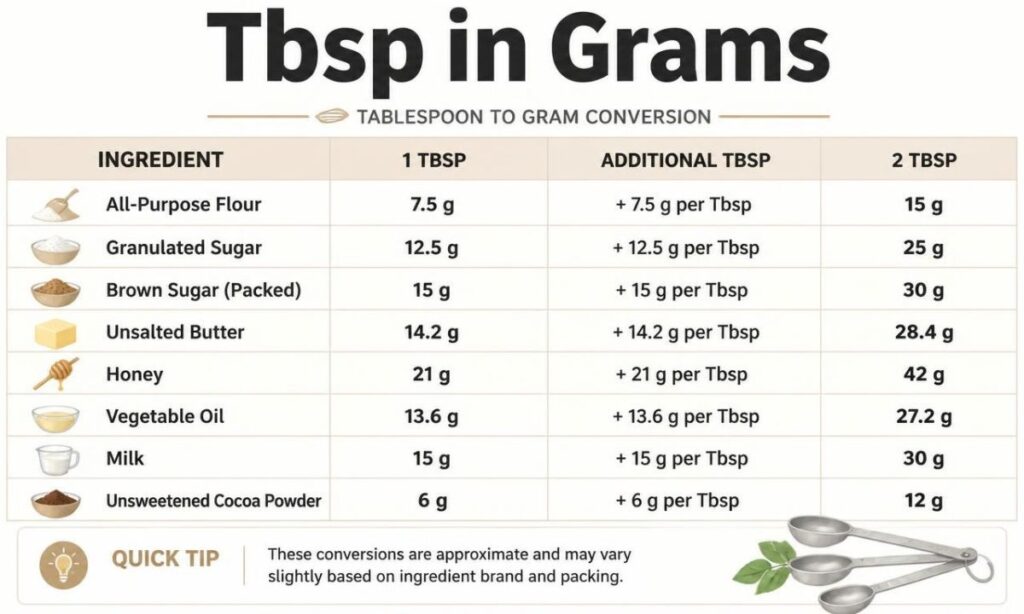
For example, using the ingredient values in this guide:
- Water = 15 g/tbsp
- Honey = 21 g/tbsp
- Milk = 15.5 g/tbsp
- Flour = 8.55 g/tbsp
- Butter = 13.8 g/tbsp
- Palm oil = 13.7 g/tbsp
- Sunflower oil = 13.8 g/tbsp
- Granulated sugar = 10.5 g/tbsp
- Brown sugar = 10.8 g/tbsp
- Powdered sugar = 8.4 g/tbsp
So, if someone asks how many grams is one tablespoon, the most accurate response is: it depends on what is inside the tablespoon.
Tablespoons to Grams: The Basic Conversion
For a simple kitchen conversion, you need the number of tablespoons and the ingredient’s grams per tablespoon value.
The basic relationship is:
grams = tablespoons × grams per tablespoon
For example, if water weighs 15 grams per tablespoon:
5 tablespoons × 15 grams = 75 grams
Therefore, 5 tablespoons of water are approximately 75 grams.
This is essentially a mass-to-volume conversion working in reverse depending on which direction you’re moving. When you’re working with a known ingredient, its density or conversion factor makes the calculation possible.
Tbsp to Grams Formula
The practical tbsp to grams formula can be written as:
grams = tablespoons × density-based conversion factor
If the density is expressed in grams per tablespoon, the calculation is particularly easy.
For example:
grams = 10 tbsp × 15 g/tbsp
grams = 150 g
So 10 tablespoons to grams of water equals approximately 150 grams.
For another ingredient, the result changes. If an ingredient has a value of 10.5 g/tbsp:
10 tbsp × 10.5 g = 105 g
Same spoon count, different mass. Thats the little detail that makes ingredient-specific conversion so important.
Grams to Tablespoons Formula
Going in the opposite direction, you can convert grams to tablespoons by dividing the mass by the ingredient’s grams-per-tablespoon value.
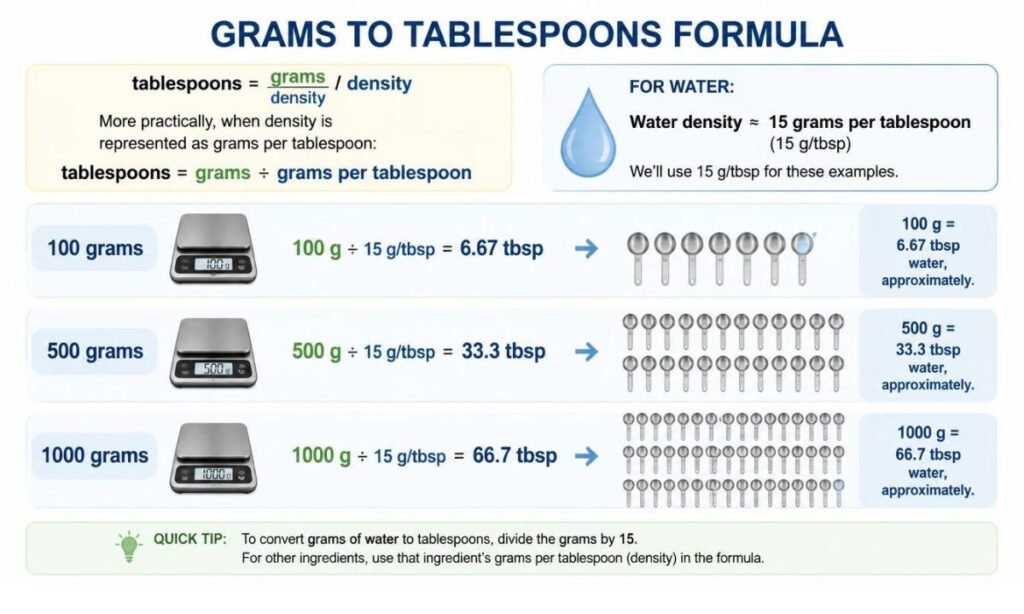
The formula is:
tablespoons = grams / density
More practically, when density is represented as grams per tablespoon:
tablespoons = grams ÷ grams per tablespoon
For water:
100 grams ÷ 15 g/tbsp = 6.67 tablespoons
So 100 g = 6.67 tbsp water, approximately.
Likewise:
500 grams ÷ 15 = 33.3 tablespoons
and:
1000 grams ÷ 15 = 66.7 tablespoons
These calculations are useful when a recipe gives ingredients by weight but you only have measuring spoons available.
Tbsp Gram Conversion Chart for Water
Water is the easiest example because its density is close to 1 gram per milliliter. Using 15 g per tablespoon, the conversion looks like this:
| Tablespoons | Grams of Water |
|---|---|
| 1 tbsp | 15 g |
| 2 tbsp | 30 g |
| 3 tbsp | 45 g |
| 4 tbsp | 60 g |
| 5 tbsp | 75 g |
| 10 tbsp | 150 g |
| 15 tbsp | 225 g |
| 20 tbsp | 300 g |
| 30 tbsp | 450 g |
| 40 tbsp | 600 g |
| 50 tbsp | 750 g |
| 100 tbsp | 1500 g |
| 200 tbsp | 3000 g |
The reverse conversion is also handy:
| Grams | Tablespoons of Water |
|---|---|
| 1 g | 0.0667 tbsp |
| 15 g | 1 tbsp |
| 30 g | 2 tbsp |
| 45 g | 3 tbsp |
| 60 g | 4 tbsp |
| 100 g | 6.67 tbsp |
| 500 g | 33.3 tbsp |
| 1000 g | 66.7 tbsp |
This is a tbsp gram conversion chart specifically for water. It should not be copied directly for flour, sugar, salt or other ingredients.
Ingredient-Specific Tbsp in Grams
Here is where ingredient-specific measurements become much more useful than a generic conversion table. Every food ingredient has its own characteristics, and even the way you fill the spoon can change the final weight.
| Ingredient | Approx. grams per tablespoon |
|---|---|
| Water | 15 g |
| Honey | 21 g |
| Milk | 15.5 g |
| Flour | 8.55 g |
| Butter | 13.8 g |
| Palm oil | 13.7 g |
| Sunflower oil | 13.8 g |
| Granulated sugar | 10.5 g |
| Brown sugar | 10.8 g |
| Powdered sugar | 8.4 g |
| Granulated salt | 19.2 g |
| Cornstarch | 10.5 g |
These values are useful estimates for cooking, but actual grams per tablespoon can vary with brand, packing, moisture, particle size and measuring technique.
How Many Grams Are in 1 Tablespoon of Water?
For water, 1 tablespoon is approximately 15 grams when using a 15 ml tablespoon.
That means:
- 1 tbsp water = 15 g
- 2 tbsp water = 30 g
- 3 tbsp water = 45 g
- 4 tbsp water = 60 g
- 10 tbsp water = 150 g
The reason this works so neatly is the relationship between water’s volume and mass. One liter of water is approximately 1000 grams under common kitchen assumptions, giving the familiar 1000 grams per liter relationship.
The often-seen 1000/15 conversion factor comes from relating 1000 grams per liter to a 15 ml tablespoon. Still, actual laboratory measurements can vary slightly with temperature, so kitchen conversions should be treated as practical approximations.
How Many Grams in a Tablespoon of Flour?
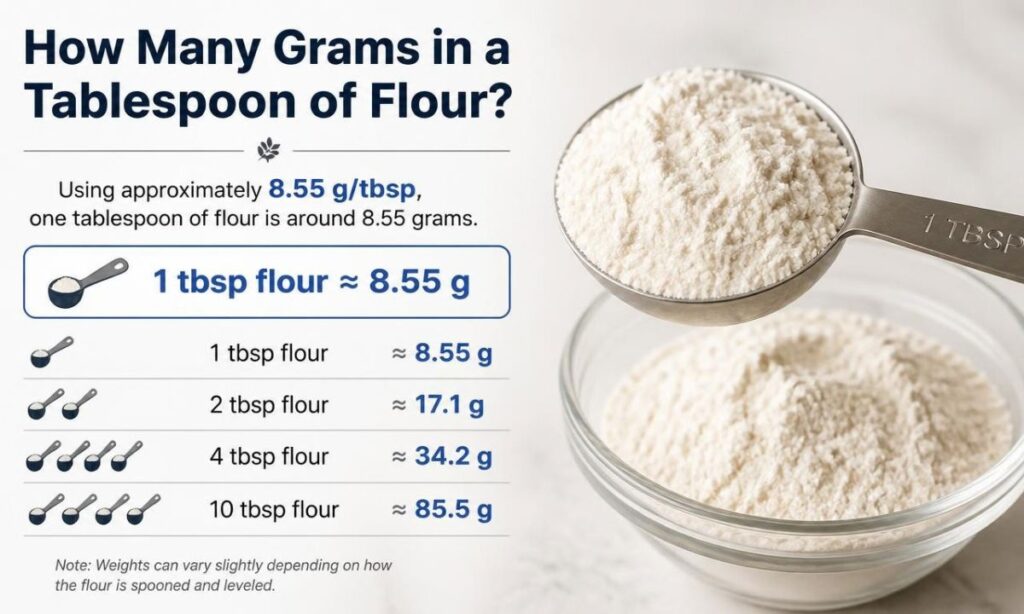
Flour is much lighter than water, so a tablespoon of flour weighs considerably less.
Using approximately 8.55 g/tbsp, one tablespoon of flour is around 8.55 grams.
That means:
- 1 tbsp flour ≈ 8.55 g
- 2 tbsp flour ≈ 17.1 g
- 4 tbsp flour ≈ 34.2 g
- 10 tbsp flour ≈ 85.5 g
However, flour is especially sensitive to how it is measured. A lightly spooned and leveled tablespoon can have a different weight from a compressed or heaped spoon. Thats why professional recipes often recommend weighing flour with a scale when precision really matters.
How Many Grams in a Tablespoon of Sugar?
Sugar comes in several forms, and they don’t all weigh the same.
For example:
- Granulated sugar ≈ 10.5 g/tbsp
- Brown sugar ≈ 10.8 g/tbsp
- Powdered sugar ≈ 8.4 g/tbsp
So the answer to how many grams in a tablespoon of sugar depends on which sugar you’re using.
If a recipe calls for 5 tablespoons of granulated sugar:
5 × 10.5 = 52.5 grams
But 5 tablespoons of powdered sugar would be approximately:
5 × 8.4 = 42 grams
The volume is identical, but the mass isn’t. Thats a perfect example of why density determines conversion.
Butter, Honey, Milk and Oils
Some of the most common cooking ingredients also show why a universal tablespoon-to-gram number doesn’t work.
Butter
One tablespoon of butter is approximately 13.8 grams using the conversion value listed here. Butter is relatively dense compared with flour, so it weighs more in the same spoon.
Honey
Honey is particularly interesting because it is heavier than water. One tablespoon is approximately 21 grams. Therefore, 3 tablespoons of honey would be around 63 grams.
Milk
One tablespoon of milk is approximately 15.5 grams. Its weight is slightly higher than an equal volume of water because milk contains fats, proteins, sugars and minerals.
Oils
The values can vary among different oils, but the examples here are:
- Palm oil = 13.7 g/tbsp
- Sunflower oil = 13.8 g/tbsp
- Coconut oil can vary depending on temperature and physical state
When converting oils, remember that their density is generally lower than water, so a tablespoon may weigh less than 15 grams.
Baking Powder, Baking Soda and Spices
Dry ingredients can become even more unpredictable because they have different particle sizes and can trap different amounts of air.
Common ingredients include baking powder, baking soda, cinnamon powder, cocoa powder, coffee powder, garlic powder, cornstarch, and various spices.
For example, a tablespoon of powdered cinnamon does not weigh the same as a tablespoon of salt. A spoon of cocoa powder can also vary depending on whether it has been loosely scooped or compressed.
This is why an ingredient-specific conversion calculator or reliable kitchen conversion chart is preferable to assuming that every tablespoon equals 15 grams.
Flat Tablespoon vs Heaped Tablespoon
A flat tablespoon and a heaped tablespoon aren’t the same measurement in practical cooking.
A flat or level spoon is filled and then leveled off, leaving the ingredient approximately flush with the top of the spoon. A heaped tablespoon contains a mound above the rim.
That difference can be surprisingly large with flour, sugar, cocoa powder and spices.
When a recipe simply says “1 tablespoon,” it generally means a standard measuring spoon rather than an enormous serving spoon piled high like a tiny mountain. For better cooking accuracy, use actual measuring spoons rather than ordinary cutlery.
Tablespoon to ML and Grams: Don’t Mix Them Up
A common mistake is assuming:
1 tbsp = 15 grams
That statement is only approximately correct for ingredients such as water where the density makes the numbers line up closely.
The more universal statement is:
1 standard tablespoon ≈ 15 ml
That is a volume measurement.
A gram, meanwhile, measures mass.
So:
tablespoon → volume
gram → mass
The connection between them comes from density. This is the basic principle behind volume-to-mass conversion and mass-to-volume conversion.
US Tablespoon vs Metric Tablespoon
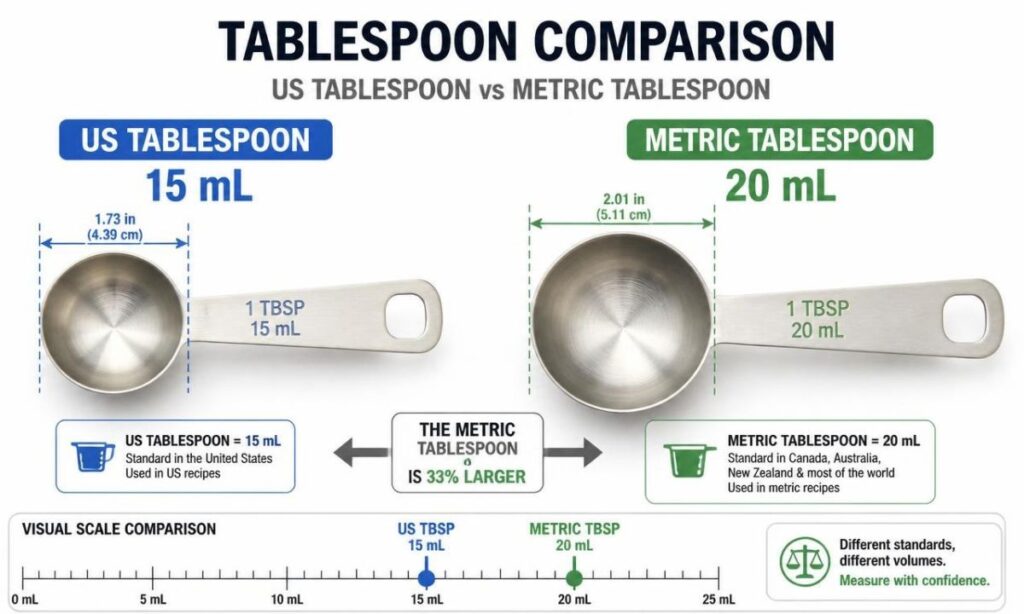
Not every country uses exactly the same tablespoon size. A US tablespoon is commonly treated as 14.79 ml, and recipes often round this to 15 ml. A metric tablespoon is generally 15 ml, while an Australian tablespoon is commonly 20 ml.
That means a recipe’s country of origin can matter.
For everyday cooking, rounding a US tablespoon to 15 ml is usually practical. But if you’re doing highly precise measurement conversion, especially in professional or scientific settings, check which standard is being used.
This is one reason online conversion tools sometimes produce slightly different answers.
How to Use a Tbsp to Grams Calculator
A tbsp to grams calculator is useful when you know the ingredient and the number of tablespoons but don’t want to calculate manually.
A good tablespoons to grams calculator needs more than just the spoon count. It should account for the ingredient or its density.
For example, to calculate 20 tablespoons of water:
20 × 15 = 300 grams
For 20 tablespoons of granulated sugar:
20 × 10.5 = 210 grams
The calculator is therefore applying an ingredient-specific conversion factor rather than blindly treating every tablespoon as 15 grams.
How to Convert Grams to Tablespoons
Suppose your recipe gives you 250 grams of an ingredient and you need to know the equivalent number of tablespoons.
First, identify the ingredient’s approximate grams per tablespoon.
For water:
250 ÷ 15 = 16.67 tbsp
For granulated sugar:
250 ÷ 10.5 ≈ 23.81 tbsp
For flour:
250 ÷ 8.55 ≈ 29.24 tbsp
Notice how dramatically the answers differ. This is the heart of gram to tablespoon conversion: you cannot accurately convert grams to tablespoons without knowing what substance you’re measuring.
Why Kitchen Scales Are More Accurate
Measuring spoons are convenient, but a kitchen scale usually provides greater precision when a recipe depends heavily on ingredient weight.
This is particularly important for:
- Baking
- Bread making
- Pastry
- Large batches
- Nutritional calculations
- Professional food preparation
- Recipes using unusual ingredients
A spoon measures volume, while a scale measures mass directly. If a recipe specifies 250 grams of flour, weighing 250 grams is generally more reproducible than trying to create exactly 29 or 30 tablespoons of flour.
Still, spoons remain wonderfully useful for small quantities. Nobody wants to weigh three grams of cinnamon every time they make toast or a weekend cake, honestly.
Measuring Spoons and Everyday Kitchen Accuracy
A proper set of measuring spoons usually contains tablespoon, teaspoon and smaller sizes. These are designed specifically for recipe measurements.
Ordinary cutlery can vary significantly in size. A decorative silver tablespoon, an everyday stainless steel spoon and a large serving spoon aren’t necessarily the same volume.
For dependable kitchen measurement conversion, use standardized measuring spoons whenever possible.
A typical set may include:
- 1 tablespoon
- 1 teaspoon
- 1/2 teaspoon
- 1/4 teaspoon
- Smaller measuring sizes
The materials, whether stainless steel, plastic, silver or other finishes, don’t determine the measurement. The actual spoon capacity does.
A Quick Table for Common Conversions
Here is a useful reference for everyday water conversions:
| Conversion | Approximate Result |
|---|---|
| 1 tbsp | 15 g |
| 2 tbsp | 30 g |
| 3 tbsp | 45 g |
| 4 tbsp | 60 g |
| 5 tbsp | 75 g |
| 10 tbsp | 150 g |
| 20 tbsp | 300 g |
| 30 tbsp | 450 g |
| 50 tbsp | 750 g |
| 100 tbsp | 1500 g |
And in reverse:
| Grams | Water, Approx. Tablespoons |
|---|---|
| 15 g | 1 tbsp |
| 30 g | 2 tbsp |
| 50 g | 3.33 tbsp |
| 100 g | 6.67 tbsp |
| 250 g | 16.67 tbsp |
| 450 g | 30 tbsp |
| 500 g | 33.3 tbsp |
| 1000 g | 66.7 tbsp |
For ingredients other than water, use their individual grams per tablespoon values rather than this water table.
Common Mistakes When Converting Tbsp to Grams
One of the biggest mistakes is treating every ingredient as if it has the same density. A tablespoon of honey and a tablespoon of flour simply don’t weigh the same, no matter how carefully you hold the spoon.
Another common mistake is ignoring whether the tablespoon is level or heaped. A large mound of flour can add a surprising amount of mass.
People also sometimes confuse tbsp, tsp, and ordinary serving spoons. A tablespoon generally equals three teaspoons, but a serving spoon from a cutlery drawer isn’t necessarily a standardized tablespoon.
Finally, don’t assume that a conversion from one country’s recipe will always transfer perfectly to another. Country-specific tablespoon sizes can create small differences, especially when many tablespoons are involved.
Tbsp in Grams: A Simple Way to Remember It
If you only need one easy rule, remember this:
A tablespoon measures volume; a gram measures mass.
For water, 1 tablespoon is approximately 15 grams. For other ingredients, look at the ingredient’s density or grams-per-tablespoon value.
The most useful formulas are:
grams = tablespoons × grams per tablespoon
and
tablespoons = grams ÷ grams per tablespoon
Once you understand that relationship, most cooking measurement conversion problems become much less mysterious.
Read more : How Many Weeks Left in 2026?
Frequently Asked Questions
How many grams are in 1 tablespoon?
It depends on the ingredient. One tablespoon of water is approximately 15 grams, while flour is around 8.55 grams, honey around 21 grams, and granulated sugar around 10.5 grams using the values in this guide.
How many grams is one tablespoon of water?
One standard 15 ml tablespoon of water is approximately 15 grams.
How many grams are in 1 tablespoon of flour?
Approximately 8.55 grams using the flour conversion value listed here. Actual weight can vary according to how the flour is scooped and leveled.
How many tablespoons are in 100 grams?
For water, 100 grams is approximately 6.67 tablespoons. For other ingredients, the answer changes according to density.
How many tablespoons are in 500 grams?
For water, 500 grams is approximately 33.3 tablespoons. You need the ingredient’s grams-per-tablespoon value for a different food.
How many tablespoons are in 1000 grams?
For water, 1000 grams is approximately 66.7 tablespoons. This should not be applied universally to every ingredient.
Is 1 tablespoon always 15 grams?
No. 1 tablespoon is a volume measurement, usually about 15 ml, while grams measure mass. Only ingredients with a density close to water will have a similar numerical value.
Can I use a normal spoon instead of a measuring tablespoon?
You can for rough cooking, but ordinary cutlery varies in size. For accurate measurements, use standardized measuring spoons.
Conclusion
The question “tbsp in grams” looks tiny on the page, but it opens the door to one of the most useful ideas in cooking: volume and mass are not the same thing. A tablespoon tells you how much space an ingredient occupies, while grams tell you how much that ingredient weighs.
Once density, ingredient type and spoon size are taken into account, the conversion becomes straightforward. Water is roughly 15 grams per tablespoon, while flour, honey, butter, sugar, salt and oils all have their own approximate values.
For casual cooking, a tablespoon conversion is often perfectly practical. For baking and recipes where precision matters, a kitchen scale is usually the better choice.
So next time a recipe asks for 10 tablespoons and your scale thinks in grams, don’t panic and don’t start measuring with the nearest soup spoon. Identify the ingredient, find its grams per tablespoon, apply the conversion formula, and you’re there. A little measurement knowledge can turn a confusing recipe into a very manageable one.
Explore More Blogs