
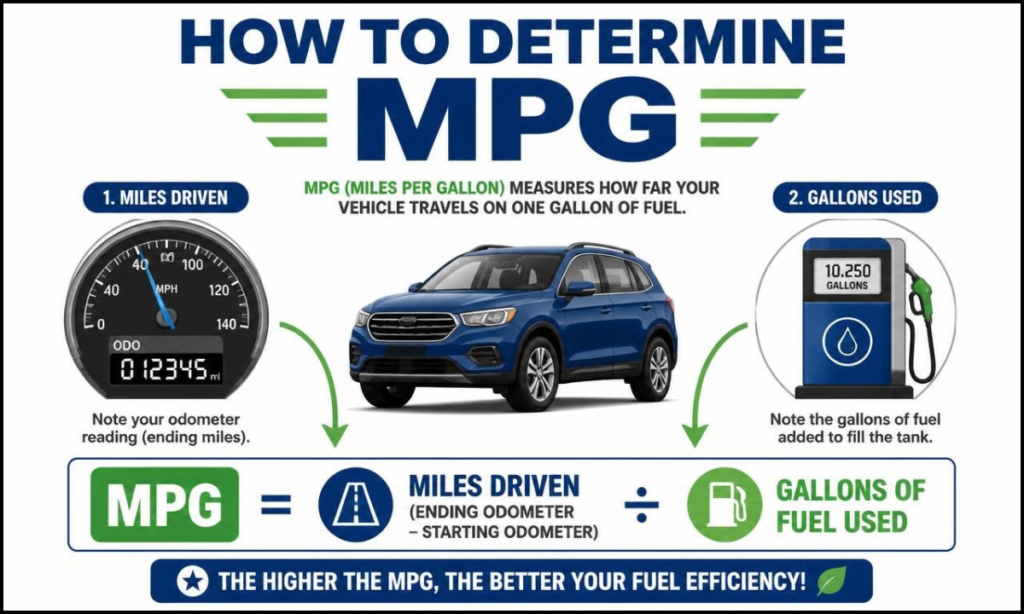
Knowing MPG can make a surprisingly big difference when you drive regularly. A car may seem economical at first glance, but the real story often appears when you compare the miles you travel with the gallons of fuel you actually use. That little number on your dashboard can tell you a lot about your vehicle, your driving habits, and even how much money disappears at the gas station.
If you’ve ever wondered how to determine MPG, the good news is that the calculation is quite simple. You only need two basic pieces of information: the distance traveled and the amount of fuel used. From there, you can calculate gas mileage, estimate trip expenses, compare vehicles, and understand your everyday fuel efficiency.
The basic idea is simple: MPG tells you how many miles your vehicle can travel using one US gallon of fuel. A car getting 30 MPG, for example, travels about 30 miles on one gallon under the conditions being measured. Real driving is a little messier than the number suggests, but the calculation itself isn’t complicated.
What Does MPG Mean?
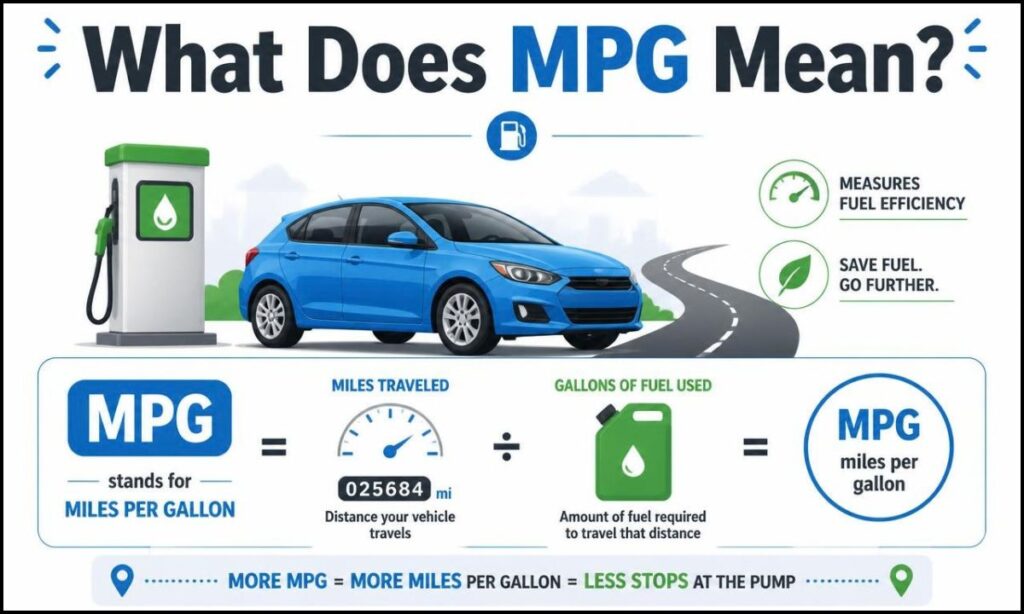
MPG stands for miles per gallon. It is a common measurement of fuel economy in the United States and describes how far a vehicle can travel using one US gallon of gasoline or another compatible fuel.
For example, if your car travels 300 miles and uses 10 gallons, its fuel economy is 30 MPG. That’s the whole basic idea, really.
The higher the MPG, the farther the vehicle travels on each gallon. A small sedan might achieve much higher MPG than a large SUV or truck, while a hybrid can often use considerably less fuel in suitable driving conditions.
It is worth remembering that MPG is not the same thing as simply looking at fuel consumption. Some countries use L/100km, or liters per 100 kilometers, where a lower number generally means better efficiency. That can feel backwards if you’re accustomed to MPG.
How to Determine MPG
The simplest way to determine MPG is to divide the distance driven by the amount of fuel consumed.
MPG = distance / fuel
Suppose you drive 350 miles and use 14 gallons of fuel:
MPG = 350 / 14
MPG = 25 MPG
So your vehicle achieved 25 miles per gallon during that trip.
This simple calculation explains how to calculate MPG from miles and gallons. You don’t need complicated equipment or special automotive knowledge. Your trip odometer and fuel receipt can usually provide everything required.
For a more accurate picture, however, you shouldn’t rely on just one short drive. Traffic, hills, weather, idling, and driving style can all change the result.
How to Calculate Gas Mileage Manually
If you’re wondering how to calculate gas mileage manually, the process can be done with a notebook, calculator, or phone.
Start by recording the odometer reading or resetting your trip odometer. Fill the tank and note how many gallons were added. Drive normally until the next refill, then record the new mileage and the number of gallons required to fill the tank again.
Now calculate the distance:
Distance = ending odometer reading − starting odometer reading
Then divide that distance by the fuel used:
MPG = distance / gallons used
For example, imagine your trip odometer shows 420 miles since the previous refill and you put 14 gallons into the tank.
MPG = 420 / 14 = 30 MPG
That means your actual MPG for that tank was approximately 30.
Small differences can happen because fuel pumps shut off at slightly different points, so repeating the process across several tanks gives a more useful average MPG.
The Tank-Fill MPG Method
The tank-fill method is one of the practical ways to measure real-world MPG because it uses actual fuel consumption instead of relying entirely on a manufacturer’s estimate.
To use the method:
- Fill the fuel tank completely.
- Record the odometer reading or reset the trip odometer.
- Drive normally.
- Fill the tank again.
- Record the number of gallons added.
- Record the miles traveled.
- Divide miles by gallons.
This is sometimes called tank-to-tank MPG.
For example, if you drive 375 miles between fill-ups and the next refill requires 12.5 gallons:
375 / 12.5 = 30 MPG
Your measured fuel economy is therefore 30 MPG.
For an even better real-world MPG calculation, repeat the process for several tanks. One unusually cold week or one long highway trip shouldn’t define your vehicle’s entire fuel economy.
How to Determine Fuel Economy From Odometer Readings
Your odometer is particularly useful when you want to understand long-term fuel usage. You can determine fuel economy by comparing two odometer readings and the amount of fuel purchased between them.
Imagine the odometer reads 48,250 miles when you begin tracking. Later it reads 48,650 miles.
Your distance is:
48,650 − 48,250 = 400 miles
If you used 16 gallons during that period:
MPG = 400 / 16 = 25 MPG
This method is helpful when you want to know how to determine fuel economy of a car without relying only on the dashboard.
For fleet operators, delivery drivers, and people who drive many miles for work, keeping these records can reveal changes in fuel usage that might otherwise go unnoticed.
How to Calculate Fuel Cost for a Road Trip
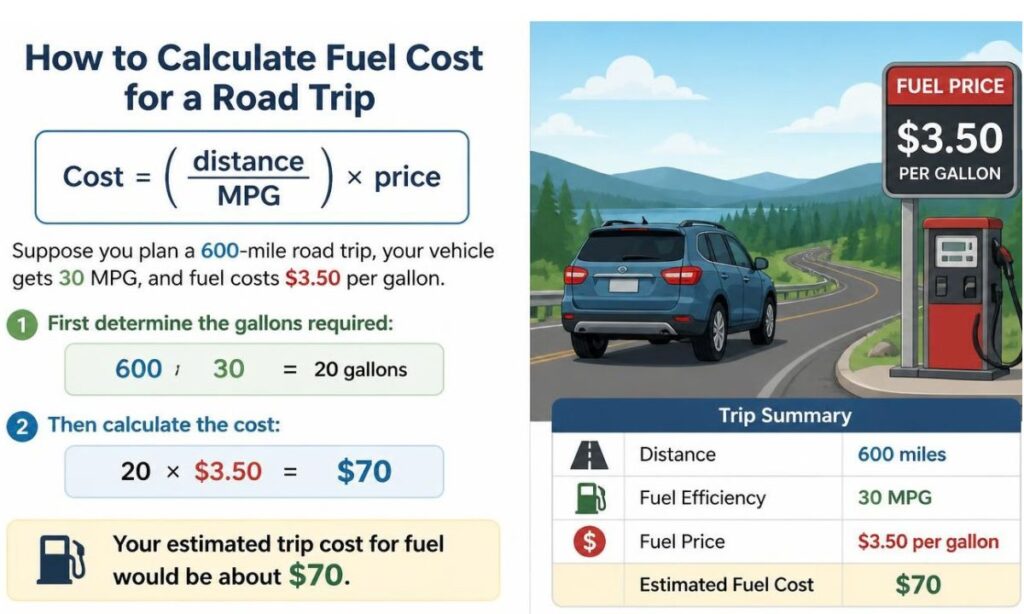
Once you know your MPG, you can estimate the fuel cost of a trip.
The formula is:
Cost = (distance / MPG) × price
Suppose you plan a 600-mile road trip, your vehicle gets 30 MPG, and fuel costs $3.50 per gallon.
First determine the gallons required:
600 / 30 = 20 gallons
Then calculate the cost:
20 × $3.50 = $70
Your estimated trip cost for fuel would be about $70.
This calculation can be useful for road-trip budgeting, especially when fuel prices are changing from place to place. It can also help you estimate how many fuel stops you’ll need.
How to Calculate Gas Cost Per Mile
Another useful measurement is cost per mile. It tells you approximately how much you spend on fuel for every mile driven.
The formula is:
Cost per mile = price per gallon / MPG
If fuel costs $3.60 per gallon and your car gets 30 MPG:
$3.60 / 30 = $0.12 per mile
So your fuel expense is approximately 12 cents per mile.
This doesn’t include insurance, maintenance, depreciation, tires, registration, or other ownership expenses. It is specifically a measurement of fuel cost.
For people involved in ride-share, delivery, or fleet management, this figure can be especially useful when estimating operating expenses.
How Many Gallons of Fuel Do I Need?
To determine how much fuel you’ll need for a particular distance, rearrange the MPG formula.
Fuel = distance / MPG
Suppose you’re traveling 500 miles and your vehicle averages 25 MPG:
500 / 25 = 20 gallons
You would need approximately 20 gallons of fuel for the journey.
If your vehicle has a 15-gallon tank capacity, you would need to plan for more than one refueling stop. Of course, you shouldn’t normally plan to empty the tank completely, because actual conditions can reduce your expected range.
How to Calculate Driving Range
You can estimate your vehicle’s driving range by multiplying MPG by available fuel.
Distance = MPG × fuel
If your vehicle gets 28 MPG and you have 12 gallons available:
28 × 12 = 336 miles
The estimated range is 336 miles.
However, this is a range estimate, not a promise. Hills, traffic, weather, speed, cargo, and driving behavior can all reduce the actual distance.
A vehicle that normally achieves 28 MPG on a warm highway journey may get considerably less during heavy city traffic or cold weather.
Why Your Real-World MPG Can Be Different
It is common for real-world MPG to differ from the advertised EPA fuel economy figure. EPA testing provides standardized measurements that make vehicle comparisons possible, but everyday driving conditions are much less controlled.
Several factors can affect fuel efficiency.
Driving Style
Aggressive acceleration, hard braking, and high cruise speed can increase fuel consumption. Smooth acceleration and maintaining a steady speed can often improve efficiency.
It isn’t about driving like a robot, either. Small changes repeated over hundreds of miles can add up.
Tire Pressure
Incorrect tire pressure can increase rolling resistance. When tires are underinflated, the engine may need to work harder to move the vehicle.
Checking tire pressure regularly is therefore useful for both safety and fuel economy.
Cold Weather
Cold weather can reduce MPG because engines and fluids operate differently before reaching their normal operating temperature. Winter conditions can also involve longer warm-up periods, snow, and different winter fuel blends.
A short winter trip can therefore produce a very different result from a long summer highway journey.
Cargo and Rooftop Equipment
Extra luggage increases vehicle weight, while rooftop cargo can increase aerodynamic drag.
A roof box, bicycles, or other equipment may make a noticeable difference during highway driving because air resistance becomes more significant as speed rises.
Traffic and Idling
Stop-and-go traffic can reduce fuel economy because the vehicle repeatedly accelerates from low speeds. Long periods of idling also consume fuel while producing little or no useful travel distance.
That’s why city MPG is often different from highway MPG.
Dashboard MPG vs. Actual MPG
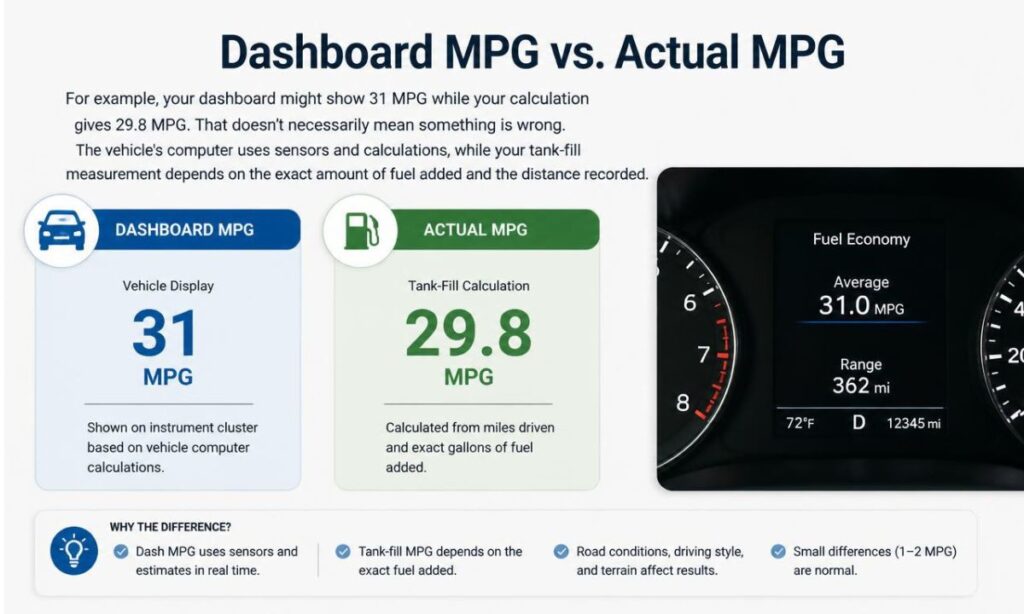
Many modern cars display Dashboard MPG or average fuel economy information. It can be convenient, but it shouldn’t automatically be treated as perfectly accurate.
If you want to investigate dashboard MPG accuracy, compare the displayed figure with your own tank-fill calculations.
For example, your dashboard might show 31 MPG while your calculation gives 29.8 MPG. That doesn’t necessarily mean something is wrong. The vehicle’s computer uses sensors and calculations, while your tank-fill measurement depends on the exact amount of fuel added and the distance recorded.
Tracking several tanks will give you a much better picture than comparing one reading.
EPA Fuel Economy and Real-World MPG
EPA fuel economy figures are useful for comparing vehicles because the same standardized testing framework is applied. You may see city, highway, and EPA combined figure ratings.
But your personal result can differ.
A person who drives mostly on highways at moderate speeds may see a different MPG than someone who makes frequent short city trips. Someone carrying heavy equipment every day will have yet another result.
So the EPA number is best viewed as a standardized reference point, while your own tank records show your vehicle’s real-world fuel economy.
MPG for Different Types of Vehicles
Fuel economy varies significantly among different vehicle categories.
A compact car or sedan often has lower weight and aerodynamic advantages compared with a large SUV. A truck may consume more fuel because of its size, weight, engine configuration, and intended workload.
A hybrid combines an internal combustion engine with electric propulsion and can be particularly efficient in stop-and-go conditions.
An electric vehicle (EV) does not consume gasoline, so traditional MPG isn’t the most appropriate measurement. EV efficiency is commonly represented using MPGe, or miles per gallon equivalent.
Understanding the measurement used by each vehicle type helps prevent confusing comparisons.
MPG (US) vs. Imperial MPG
One important detail is that a US gallon and an Imperial gallon are not the same size.
One US gallon equals approximately:
3.78541 liters
One Imperial gallon equals approximately:
4.54609 liters
Because an Imperial gallon contains more liquid, a vehicle’s MPG number will appear higher when expressed in Imperial MPG than in US MPG.
This is why US gallon vs Imperial gallon matters whenever you’re comparing fuel economy information from different countries.
One mile is approximately:
1.609344 kilometers
These conversions are especially important when reading international automotive specifications.
How to Convert MPG to km/L
If you’re working with international fuel economy units, you may need to convert MPG into kilometers per liter.
For US MPG:
km/L = MPG × 0.425144
For example, a vehicle achieving 30 US MPG would be:
30 × 0.425144 = 12.75 km/L
So 30 US MPG is approximately 12.75 kilometers per liter.
This makes MPG to kilometers per liter conversion relatively straightforward once you have the correct factor.
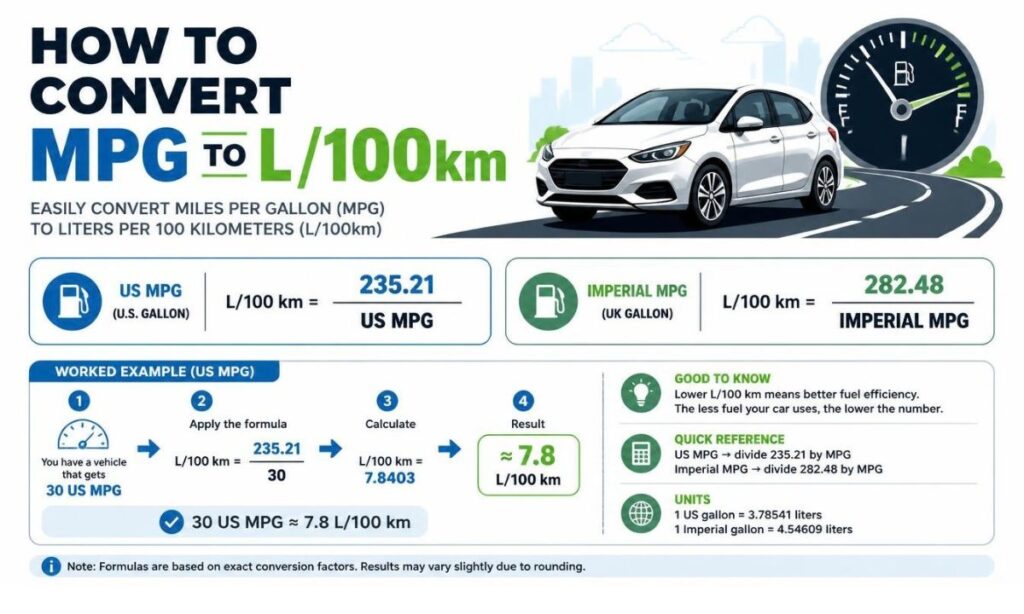
How to Convert MPG to L/100km
Many countries use L/100km, or liters per 100 kilometers, instead of MPG.
The conversion is:
L/100km = 235.215 / MPG
For a vehicle achieving 30 MPG:
235.215 / 30 = 7.84 L/100km
So 30 US MPG is approximately 7.84 liters per 100 kilometers.
Notice something interesting here: with L/100km, a lower number represents better efficiency. That’s the opposite direction from MPG, where a higher number generally means better fuel economy.
Important Fuel Economy Formulas
Keeping the core formulas together makes it easier to calculate different parts of your trip.
MPG = distance / fuel
Distance = MPG × fuel
Fuel = distance / MPG
Cost = (distance / MPG) × price
Cost per mile = price per gallon / MPG
L/100km = 235.215 / MPG
km/L = MPG × 0.425144
For metric measurements:
L/100km = (fuel in liters / distance in km) × 100
Once you understand these relationships, you can calculate MPG, fuel requirements, driving range, and fuel expenses without needing a dedicated calculator every time.
Using an MPG Calculator
A gas mileage calculator, fuel economy calculator, or MPG calculator simply automates the same basic mathematics.
You normally enter the distance traveled and fuel consumed, and the calculator produces the MPG value.
Some tools can also calculate:
- Fuel needed for a trip
- Estimated fuel cost
- Cost per mile
- Driving range
- MPG conversions
- Annual fuel expenses
- Trip fuel requirements
- L/100km and km/L equivalents
These tools are handy when planning a long journey, comparing vehicles, or keeping track of your monthly fuel budget.
Still, understanding the manual calculation is worthwhile. If the calculator ever gives you a number that looks strange, you’ll know how to check it.
How to Estimate Annual Fuel Expenses
You can also use MPG to estimate your yearly gasoline spending.
Suppose you drive 15,000 miles each year, your vehicle gets 30 MPG, and fuel averages $3.50 per gallon.
First:
15,000 / 30 = 500 gallons
Then:
500 × $3.50 = $1,750
Your estimated annual fuel cost would be $1,750.
If your MPG improves to 35 while everything else stays the same:
15,000 / 35 = 428.57 gallons
At $3.50 per gallon, that’s about $1,500.
The difference illustrates why tracking fuel economy can be useful when creating a yearly fuel budget.
How to Improve Your MPG
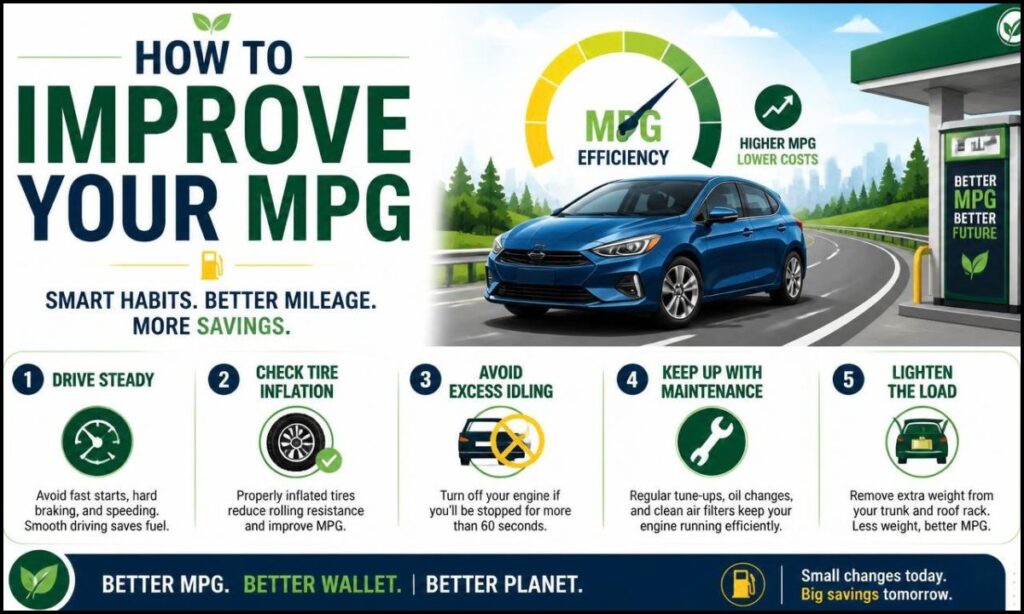
Once you’ve learned how to determine MPG, the next natural question is whether you can improve it.
Start with simple habits. Keep your tires properly inflated, avoid unnecessary heavy cargo, accelerate smoothly, and maintain a reasonable speed. Regular vehicle maintenance also matters because problems with the engine, tires, brakes, or other systems can influence vehicle performance and fuel consumption.
Try combining errands rather than making multiple short trips. On longer journeys, maintaining a steady speed can often be more efficient than repeatedly accelerating and braking.
And don’t forget the basics: an accurate MPG measurement gives you something to improve. Without measuring, you’re mostly guessing.
Common Mistakes When Calculating MPG
One common mistake is dividing gallons by miles instead of miles by gallons. That produces a different measurement.
Another mistake is using a partial tank without carefully recording how much fuel was actually consumed. The calculation can still work, but it becomes easier to introduce errors.
People also sometimes confuse the vehicle’s advertised MPG with their own actual fuel economy. EPA figures and dashboard readings can be useful references, but your own repeated measurements tell you how the vehicle performs under your particular conditions.
Finally, always check whether you’re dealing with US MPG or Imperial MPG before comparing figures from international sources.
Why Knowing Your MPG Matters
Understanding your vehicle’s fuel economy is about more than saving a few dollars here and there.
It helps you plan a road trip, estimate fuel stops, calculate the number of gallons needed for a trip, and understand the ongoing cost of driving. For businesses, it can help with fleet management, delivery planning, and operating-cost analysis.
It can even reveal changes in your vehicle. If your usual 30 MPG suddenly becomes 22 MPG under similar conditions, that may be worth investigating.
In other words, MPG is a small number carrying quite a bit of information.
Read more : How Many Months Till September?
Frequently Asked Questions
How to Calculate MPG From Miles and Gallons
To determine MPG, divide the total miles driven by the gallons of fuel used. The result shows how many miles your vehicle travels per gallon.
How to Determine MPG From a Full Tank
Fill your tank, reset the trip odometer, and drive normally until the next refill. Divide the miles driven by the gallons added at the next fill-up.
How to Calculate Gas Mileage Manually
Record your starting and ending mileage, then calculate the distance traveled. Divide that distance by the fuel consumed to find your actual gas mileage.
How to Calculate Fuel Cost Using MPG
Divide the trip distance by your MPG to find the gallons needed, then multiply by the price per gallon. This gives you an estimate of the total fuel cost.
Conclusion
Learning how to determine MPG is one of those small pieces of practical knowledge that keeps paying you back. The central formula is wonderfully simple:
MPG = distance / fuel
Record the miles you travel, record the gallons you use, divide the two, and you’ve got your fuel economy.
For the most reliable real-world MPG, use the tank-fill method across several refueling cycles rather than depending on one trip or one dashboard number. From there, you can calculate fuel costs, cost per mile, driving range, trip requirements, and even your approximate annual fuel expenses.
Whether you drive a sedan, SUV, truck, hybrid, or another type of vehicle, knowing your actual fuel consumption gives you a clearer picture of what every mile really costs.
And perhaps that’s the nicest part of the whole calculation: a few numbers from your odometer and fuel receipt can turn an everyday drive into useful information. Once you know your MPG, you’re no longer just filling the tank—you understand where the fuel is going.