

Sometimes a date looks like it is hiding somewhere just beyond the calendar page you are staring at. You know it is coming, you know roughly when it should arrive, but counting those little squares on the calendar feels strangely annoying. That is where knowing what is two weeks from today becomes useful.
It is a simple question, but the answer can matter when you are planning appointments, deadlines, trips, events, reminders, payments, or even just waiting for something you are looking forward to.
Today is September 21, 2026, so two weeks from today is October 5, 2026. The calculation is straightforward: two weeks contain 14 days, and adding 14 days to September 21 brings us to October 5. Nothing mysterious about it, though calendars can make simple things feel oddly complicated sometimes.
A weeks calculator or date calculator can make this kind of date calculation almost instant. You enter the starting date, choose how many weeks to add, and the tool gives you the resulting date. It can be handy when the date is farther away, because counting manually across several months is where mistakes start sneaking in.
What Is Two Weeks From Today?

If you are asking what date is two weeks from today, the answer depends on what “today” means at the moment you perform the calculation. For today, September 21, 2026, the answer is October 5, 2026.
The basic idea is very simple. One week equals 7 days, so two weeks equals 14 days. Add those 14 days to the current reference date, and you get the future date. A person can count it on a calendar, of course, but using a calculator is usually quicker and less prone to those little counting slips.
- Today: September 21, 2026
- One week from today: September 28, 2026
- Two weeks from today: October 5, 2026
- Total time: 14 days
- Period covered: 14-day period
So, if someone asks you what is two weeks from today, you can simply say October 5, 2026 based on today’s date.
What Date Is Two Weeks From Today?
The phrase what date is two weeks from today is essentially asking for a future calendar date. You are taking today as your base date and moving forward exactly 14 days.
For example, imagine you have an appointment on September 21 and somebody tells you to check back in two weeks. You would move seven days forward to September 28, then another seven days forward to October 5. That is your date after two weeks.
It can also be useful to think in terms of weekdays. September 21, 2026, falls on a Monday, and October 5, 2026, is also a Monday. Every complete seven-day period returns you to the same weekday, which makes two weeks later particularly easy to recognize.
A quick summary looks like this:
| Starting Date | Period Added | Result |
|---|---|---|
| September 21, 2026 | 7 days | September 28, 2026 |
| September 21, 2026 | 14 days | October 5, 2026 |
| September 21, 2026 | 2 weeks | October 5, 2026 |
This is a small piece of calendar date calculation, but it is useful in everyday planning more often than people might expect.
How to Calculate Two Weeks From Today
To calculate two weeks from today, you only need to remember one rule: one week has seven days. Two weeks therefore contain 14 days.
Start with today’s date and count forward 14 calendar days. With September 21 as the starting date, the first seven days take you to September 28. Seven more days take you to October 5. That gives you the exact future date.
The calculation can be written simply:
September 21, 2026 + 14 days = October 5, 2026
Another way to understand it is:
2 weeks × 7 days = 14 days
Then:
September 21 + 14 days = October 5
This kind of time calculation is easy when the dates are close together, but a date calculator tool becomes more useful when you are working with several weeks, months, or a large date range.
Two Weeks From Now Means 14 Days
People often use “two weeks from now,” “two weeks later,” and “14 days from today” to mean almost exactly the same thing. They all describe a future point that is 14 days after the reference date.
For example, if today is September 21, then:
- Two weeks from now = October 5
- Two weeks later = October 5
- 14 days from today = October 5
- 14 days from now = October 5
- Date two weeks from today = October 5
There is no need to treat these as different mathematical calculations. They are different expressions for the same two-week interval, unless someone gives you a special counting convention or says that the starting day should be included.
That last detail can occasionally cause confusion. In ordinary date arithmetic, adding 14 days means moving forward 14 complete days. It does not mean counting September 21 as day one and stopping after day 14. Date tools normally perform the addition in the former way.
Using a Weeks Calculator
A Weeks Calculator is helpful when you do not want to manually count days. Most date calculators offer a few basic operations that cover nearly every common situation.
You may see an Operation Type section with choices such as:
- Add Weeks
- Subtract Weeks
- Weeks Between
For a question like this one, choose Add Weeks. Enter September 21, 2026 as the Start Date, enter 2 as the number of weeks, and select Calculate. The calculation results should show October 5, 2026.
A typical calculator process looks something like this:
Operation Type → Add Weeks → Start Date → 2 Weeks → Calculate
If the tool provides a Clear button, you can reset the calculator inputs and perform another calculation. This is particularly convenient when checking several upcoming dates in a row.
The nice thing about an online weeks calculator is that you do not need to worry about whether a month has 28, 30, or 31 days. The tool handles the calendar arithmetic for you, which saves a surprising amount of tiny mental effort.
Add Weeks to a Date
The add weeks to a date function is useful whenever you need to find an upcoming date based on a known starting point. Instead of asking what is two weeks from today, you might ask what is 7 weeks from a particular appointment.
The principle does not change.
If your starting date is September 21, 2026:
- Add 1 week → September 28, 2026
- Add 2 weeks → October 5, 2026
- Add 3 weeks → October 12, 2026
- Add 4 weeks → October 19, 2026
- Add 7 weeks → November 9, 2026
This shows why a weeks from now calculator can be useful. Once the number becomes larger, manually counting each week gets a bit tedious, and nobody really wants to lose five minutes arguing with a calendar.
Subtract Weeks From a Date
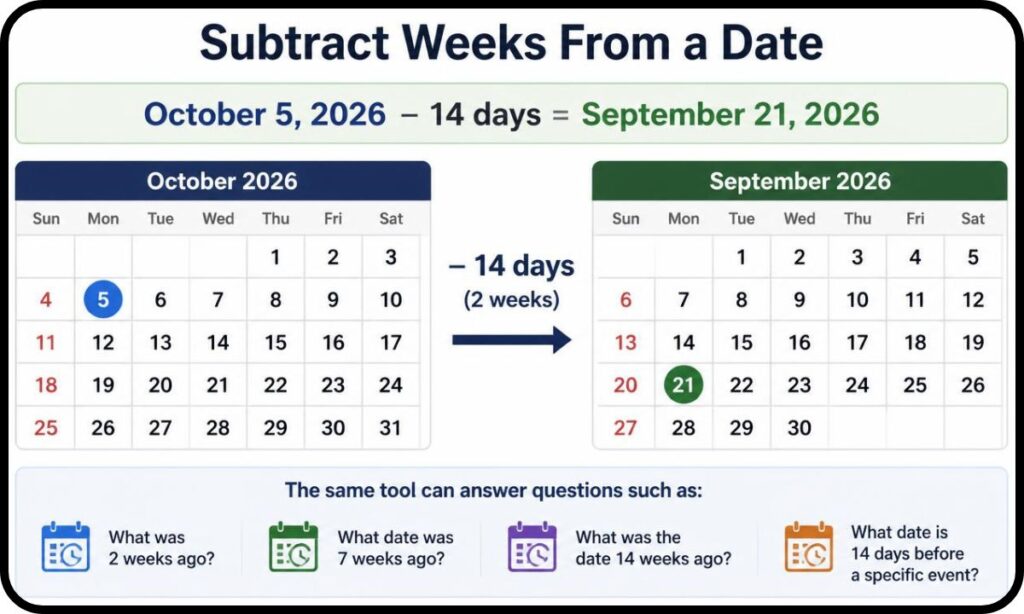
Calculating backward works in exactly the same way. Instead of using Add Weeks, choose Subtract Weeks.
Suppose October 5, 2026 is your reference date and you want to know what date was two weeks earlier. Subtract 14 days:
October 5, 2026 − 14 days = September 21, 2026
You can also subtract 14 days directly when using a date calculator. This is helpful for deadlines, previous appointments, project planning, or finding the beginning of a two-week period.
The same tool can answer questions such as:
- What was 2 weeks ago?
- What date was 7 weeks ago?
- What was the date 14 weeks ago?
- What date is 14 days before a specific event?
So the calculator is not only about future dates. It works backward too, which is sometimes where the calendar gets a little slippery.
Weeks Between Dates
There is another common question that sounds similar but requires a different operation: how many weeks are there between two dates?
For this, you would use Weeks Between rather than Add Weeks. You enter a Start Date and an End Date, and the calculator determines the number of weeks separating them.
For example, imagine the dates are December 1, 2022 and December 25, 2024. A weeks between dates calculation can determine the total time interval rather than simply adding a fixed number of weeks to one date.
This distinction matters:
- Add Weeks finds a future date.
- Subtract Weeks finds a previous date.
- Weeks Between measures the distance between two dates.
A date difference calculation can also be expressed in days, weeks, months, or sometimes years, depending on the calculator being used.
Two Weeks Is a Two-Week Period
A two-week period is exactly 14 days when measured as two complete weeks. It is long enough to feel meaningful but short enough that people often use it for practical planning.
Businesses may use two-week schedules for payroll or project cycles. Families may use a 14-day period when planning holidays. Students sometimes think in two-week blocks when organizing assignments, while people arranging appointments may simply say, “I’ll see you in two weeks.”
It is also useful because the weekday stays the same. A Monday followed by one week is another Monday, and two weeks later it is Monday again. That little calendar trick makes recurring appointments easier to remember.
For September 21, 2026, the two-week period ends on October 5, 2026.
Why Exact Date Calculation Matters
It may seem almost silly to use a calculator for something as small as 14 days, but exact date calculation becomes valuable when dates are connected to real commitments.
Imagine a payment deadline, a return period, a travel booking, a work review, or an appointment. Being off by one day can turn a harmless little calculation into an unnecessary headache.
An exact date calculation gives you a clear reference date, a defined interval, and a specific end date. That makes planning easier and reduces ambiguity when you need to communicate the date to someone else.
Instead of saying “sometime in two weeks,” you can say, “October 5.” Much cleaner, and nobody has to pull out their calendar during the conversation.
What About Seven Weeks From Today?
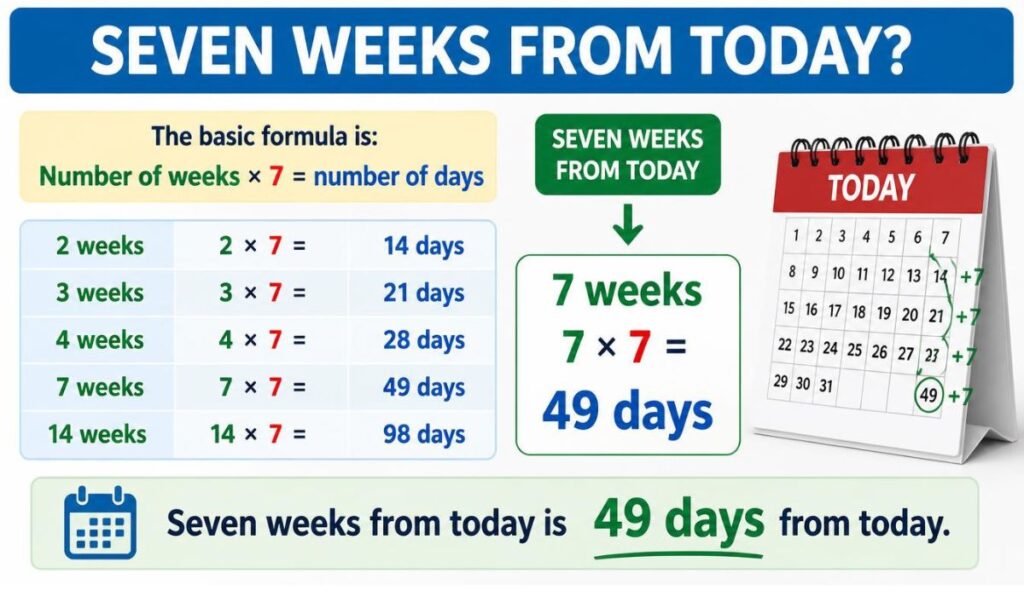
Once you understand two weeks, larger intervals become simple. 7 weeks contains 49 days because seven weeks multiplied by seven days equals 49.
Starting from September 21, 2026, adding 7 weeks gives November 9, 2026. A calculator can handle this instantly, but it is still useful to understand the underlying arithmetic.
The basic formula is:
Number of weeks × 7 = number of days
So:
- 2 weeks = 14 days
- 3 weeks = 21 days
- 4 weeks = 28 days
- 7 weeks = 49 days
- 14 weeks = 98 days
This relationship is the foundation behind most weeks calculation tools.
Weeks From a Specific Date
You do not actually need today to calculate a future date. Any calendar date can become your reference date.
For example, if your starting date is February 15, 2027, you can calculate two weeks later by adding 14 days. The same approach works for dates such as December 1, 2022 or December 25, 2024.
This is why a date calculator is more flexible than simply searching for “two weeks from today.” It lets you calculate from a particular date even when that date is not the current day.
You might ask:
- What date is two weeks after my starting date?
- What date is 14 days before the deadline?
- How many weeks are between two dates?
- What is the date 7 weeks from a specific event?
- What was the date 14 weeks ago?
All of these are variations of basic date arithmetic.
How to Use a Date Calculator Correctly
Using a date calculator tool is usually straightforward, but entering the right information matters. A calculator can only work with the dates and settings you provide, so double-checking the inputs is always worthwhile.
First, select the appropriate Operation Type. If you want a future date, choose Add Weeks. If you need an earlier date, select Subtract Weeks. If you want to measure the interval between two calendar dates, choose Weeks Between.
Next, enter the Start Date or reference date. Add the number of weeks, then press Calculate. Review the calculation results before using the date for an important appointment or deadline.
Some tools may also allow you to switch between days and weeks. That is handy when comparing a 14-day period with a two-week period, because they represent the same amount of time.
Common Mistakes When Counting Two Weeks
The biggest mistake is usually counting the starting day as part of the 14 days. When you say “14 days from September 21,” ordinary date addition moves forward 14 days, resulting in October 5.
Another common mistake happens when people cross from one month into another. September has 30 days, so after September 21 there are only nine days remaining before September ends. The remaining five days fall in October, bringing the result to October 5.
Some people also confuse “two weeks from today” with “two Sundays from now” or another weekday-based phrase. Those can sometimes mean the same thing, but only if the starting day and counting method line up.
When the date matters, an exact date difference calculator or future date calculator is a safer choice than guessing from memory.
Weeks From Now vs. Weeks Ago

The phrase weeks from now points forward in time, while weeks ago points backward.
For today’s reference date of September 21, 2026:
Two weeks from today → October 5, 2026
If you instead ask for two weeks ago:
Two weeks ago → September 7, 2026
The difference is simply the direction of the calculation. Adding moves into the future, while subtracting moves into the past.
That may sound obvious, but once you start working with several dates at once, writing down whether you are adding or subtracting can save you from a very avoidable mistake.
Practical Uses for a Two-Week Date
Knowing the date two weeks from today can be useful in many ordinary situations. You might be scheduling a follow-up appointment, planning a short trip, checking a work deadline, organizing a study plan, or deciding when to send a reminder.
A two-week interval is also common in personal planning. Someone may say, “Let’s review this in two weeks,” and having the exact date immediately turns that vague promise into something concrete.
For today’s date, that concrete date is October 5, 2026.
You can even create a simple two-week planning block:
- September 21 — starting point
- September 28 — one-week mark
- October 5 — two-week endpoint
This makes the date range visually easier to understand, especially when several tasks need to fit inside it.
How to Calculate Weeks Between Dates
If your goal is not to find a future date but to determine the number of weeks between two dates, use the difference between the dates.
For complete weeks, divide the number of days by seven. For example, if two dates are 28 days apart, they are exactly four weeks apart.
The general idea is:
Date difference in days ÷ 7 = number of weeks
If the result is not a whole number, you may have a combination of weeks and days. For example, 17 days equals two weeks and three days.
A proper weeks between dates calculator can perform this calculation automatically and may provide both the total days and the equivalent weeks.
A Simple Way to Remember Two Weeks From Today
If you do not have a calculator nearby, remember this tiny shortcut: two weeks means two Mondays, two Tuesdays, two Wednesdays, and so on.
Starting on Monday, September 21, 2026:
- First Monday: September 28
- Second Monday: October 5
So October 5 is the date exactly two weeks later.
The trick works regardless of the weekday. If today is Thursday, two weeks from today will also be Thursday. The calendar does not change its weekday pattern just because a new month appears, thankfully.
Read more : How Many Weeks Until May 20th?
Frequently Asked Questions
What is two weeks from today?
Based on September 21, 2026, two weeks from today is October 5, 2026. Two weeks equal 14 days, so the calculation is September 21 plus 14 days.
What date is two weeks from today?
The date two weeks from September 21, 2026, is October 5, 2026. This is found by adding two complete seven-day periods.
How many days are two weeks?
Two weeks contain 14 days. One week contains seven days, so multiplying seven by two gives 14.
What is 14 days from today?
If today is September 21, 2026, then 14 days from today is October 5, 2026. “14 days from today” and “two weeks from today” describe the same interval.
What date was two weeks ago?
Two weeks before September 21, 2026, was September 7, 2026. This uses subtraction rather than addition.
Can a weeks calculator find a date in the future?
Yes. A weeks calculator can generally add a selected number of weeks to a starting date. It can also often subtract weeks or calculate the number of weeks between dates.
What is the difference between a date calculator and a weeks calculator?
A date calculator can handle several types of calendar arithmetic, while a weeks calculator focuses specifically on adding, subtracting, or comparing weeks. Their functions may overlap depending on the tool.
Conclusion
The question “what’s two weeks from today?” looks tiny, but it is one of those useful little date questions that comes up constantly. Whether you are planning an appointment, marking a deadline, arranging a trip, or simply wondering when a future date arrives, knowing how to calculate the answer makes planning feel much less fuzzy.
For today, September 21, 2026, the answer is clear: October 5, 2026. That is 14 days, two complete weeks, and one neat little jump across the September-October boundary.
You can always count the days manually, but a weeks calculator, date calculator, or future date calculator makes larger calculations easier. Just choose the right operation, enter the starting date, and check the resulting end date.
And perhaps the nicest thing about two weeks is that it is short enough to see coming but long enough for something to actually change. A project can move forward, a plan can take shape, and a calendar that looked empty can suddenly have a destination written on it. Sometimes, all you really need is the right date.