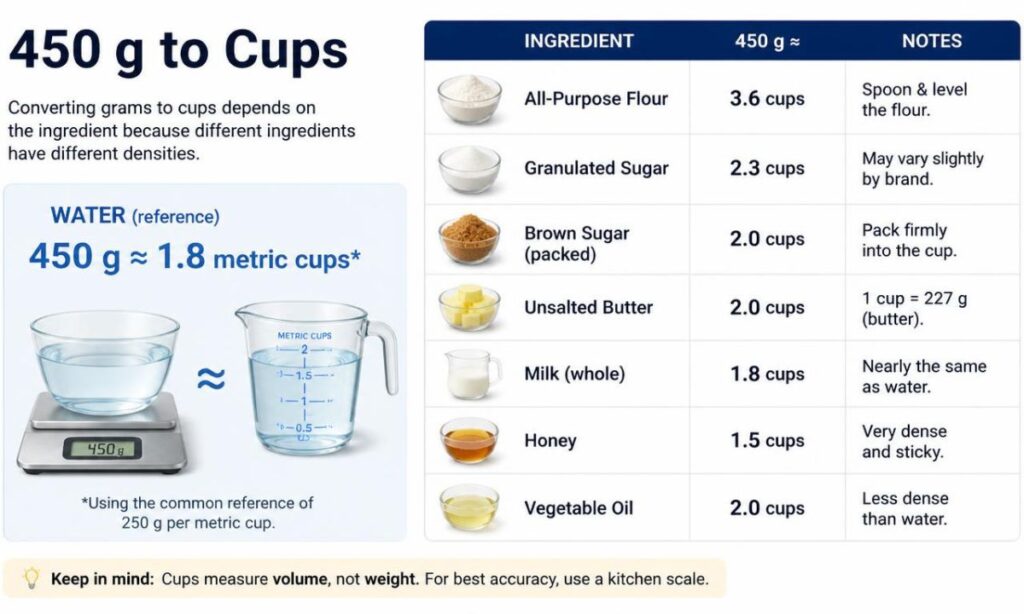
When a recipe says 450 grams, but your measuring cups are sitting beside you looking much more useful than the kitchen scale, the obvious question appears: how many cups do you actually need? This is where 450g to cups conversion gets a little interesting, because grams and cups do not measure the same thing.
A gram measures mass or weight, while a cup measures volume. So, 450 grams of flour will not necessarily occupy the same number of cups as 450 grams of honey, butter, or sugar. It sounds like a tiny kitchen detail, but it can change a recipe quite a bit.
For a quick starting point, 450 grams of water is about 1.8 metric cups when using the common reference of 250 grams per metric cup. For other ingredients, though, the answer can be noticeably different.
450g to Cups: The Quick Answer
If you are searching for 450g to cups, there is no single answer that works perfectly for every ingredient. The ingredient’s density is the important missing piece, and honestly, thats the part many simple online conversions skip.
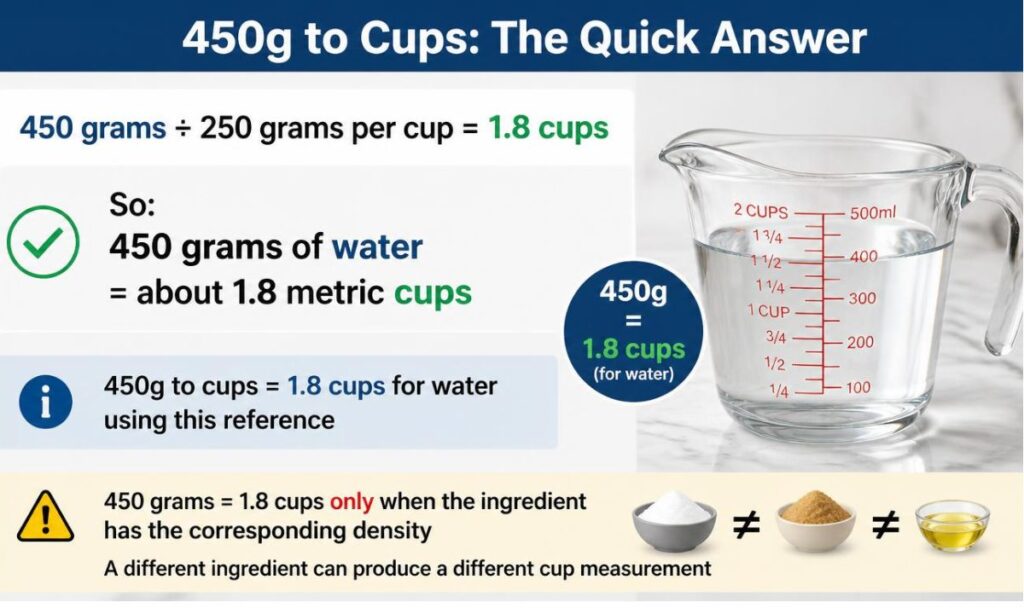
Using the supplied reference system where 1 metric cup of water is approximately 250 grams, the calculation is:
450 grams ÷ 250 grams per cup = 1.8 cups
So:
- 450 grams of water = about 1.8 metric cups
- 450g to cups = 1.8 cups for water using this reference
- 450 grams = 1.8 cups only when the ingredient has the corresponding density
- A different ingredient can produce a different cup measurement
This is why a grams to cups converter normally needs you to select an ingredient rather than simply enter a number and expect one universal answer.
450 Grams in Cups for Common Ingredients
The easiest way to understand 450 grams in cups is to look at common kitchen ingredients. Their weights per cup vary because flour, sugar, butter, oil, and other foods have different densities.
Here is a useful reference table. Values are approximate, because packing, scooping method, moisture, and ingredient type can all affect the final measurement.
| Ingredient | Approx. grams per cup | 450g is approximately |
|---|---|---|
| Water | 250 g | 1.8 cups |
| Flour | 120–130 g | 3.5–3.75 cups |
| Granulated sugar | 200 g | 2.25 cups |
| Brown sugar | 200–220 g | 2–2.25 cups |
| Powdered sugar | 120–125 g | 3.6–3.75 cups |
| Butter | 225–230 g | About 2 cups |
| Honey | 330–340 g | About 1.3 cups |
| Milk | About 250 g | About 1.8 cups |
| Cocoa powder | 85–90 g | About 5 cups |
| Cornstarch | 125–130 g | About 3.5 cups |
These figures are intended for practical cooking measurements, not laboratory work. For baking, weighing the ingredient directly is usually more dependable when precision matters.
Why 450g Does Not Always Equal the Same Number of Cups
The confusion becomes much easier once you separate weight from volume. A gram tells you how heavy something is, while a cup tells you how much physical space it occupies.
Imagine holding 450 grams of flour and 450 grams of honey. Both weigh 450 grams, obviously, but honey is much denser. The honey therefore takes up less space than the fluffy flour. Thats the whole trick behind the conversion.
This property is called density. In simple terms, density describes how much mass is contained within a particular volume.
That means a proper weight to volume conversion depends on three things:
- The ingredient being measured
- Its approximate density
- The type of cup being used
Without those details, saying that 450 grams always equals one fixed number of cups can be misleading.
The Formula for Converting 450g to Cups
A basic conversion formula can help when the density of an ingredient is known.
Cups = grams ÷ grams per cup
For example, suppose an ingredient weighs approximately 125 grams per cup.
450 ÷ 125 = 3.6 cups
So 450 grams of that ingredient would occupy roughly 3.6 cups.
Water gives another simple example. Using 250 grams per metric cup:
450 ÷ 250 = 1.8 cups
This formula is useful for a grams to cup conversion, but the quality of the answer depends on the grams-per-cup value you use. If that value is inaccurate, the final cup measurement will be inaccurate too.
450g to Cups for Flour
Flour is one of the ingredients that causes the most kitchen-conversion confusion. A cup of flour can weigh differently depending on whether it has been spooned gently into the cup, scooped directly from the bag, or compressed.
For a practical reference, all-purpose flour is often treated as roughly 120–130 grams per cup. Using 125 grams as a simple estimate:
450 ÷ 125 = 3.6 cups
Therefore, 450g of flour is approximately 3.6 cups under that reference.
That is roughly 3 ½ cups plus a little extra. If your recipe is delicate, especially a cake or pastry, using a kitchen scale is still the better choice because flour is surprisingly easy to overpack.
450g to Cups for Sugar
Sugar behaves differently from flour, and even different types of sugar have different measurements. Granulated sugar, for example, is considerably heavier per cup than flour.
Using approximately 200 grams per cup for granulated sugar:
450 ÷ 200 = 2.25 cups
So 450 grams of granulated sugar is about 2.25 cups, or 2 ¼ cups.
Brown sugar can vary because it is often packed into the measuring cup. Powdered sugar is lighter and takes up more space, so its cup equivalent can be much larger. Its a good example of why ingredient-specific conversion matters.
450g to Cups for Butter
Butter is a little easier because it is commonly sold in standardized blocks or sticks, depending on the country. Still, recipes may list butter by grams, cups, tablespoons, or sticks, which can make things feel needlessly complicated.
Using approximately 227 grams per cup:
450 ÷ 227 ≈ 1.98 cups
So 450 grams of butter is approximately 2 cups.
This is one of those conversions where the rounded answer is wonderfully convenient. If your recipe calls for 450 grams of butter, thinking of it as roughly 2 cups can be useful for quick kitchen planning.
450g to Cups for Honey and Oil
Honey provides a nice demonstration of ingredient density. It is much heavier per cup than water, so 450 grams of honey takes up considerably less than 1.8 cups.
Using approximately 335 grams per cup:
450 ÷ 335 ≈ 1.34 cups
That means 450 grams of honey is around 1.3 cups.
Oil is different again. It is less dense than water, so the same 450-gram weight will occupy more volume than 450 grams of a denser liquid. This is why you should not simply use a water conversion for coconut oil, palm oil, or sunflower oil.
US Cup, Metric Cup, and UK Cup Differences
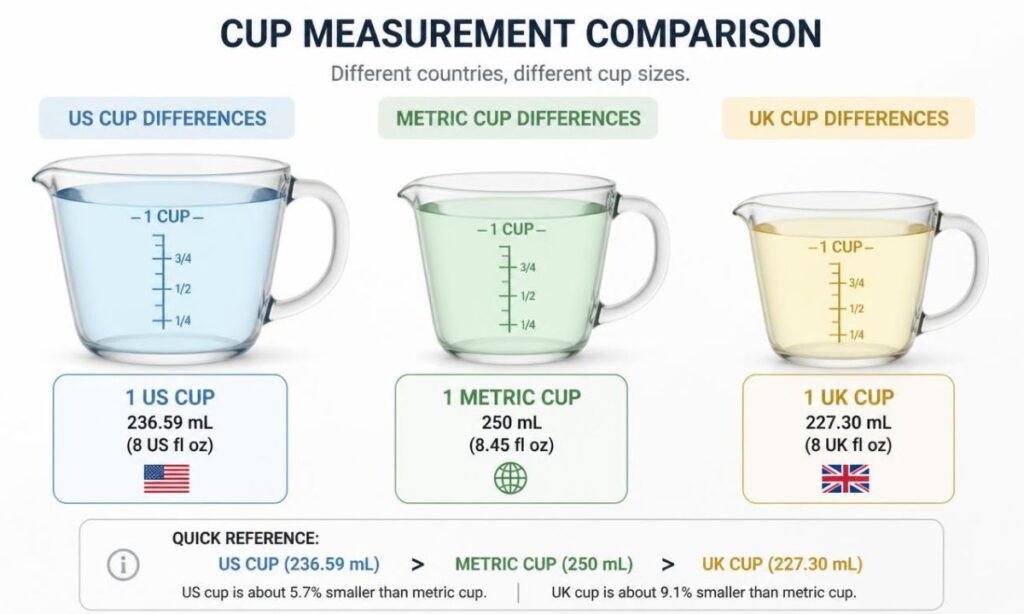
Another little wrinkle in 450g to cups conversion is that not every cup means exactly the same volume around the world.
A US cup is approximately 236.6 milliliters, while a metric cup is commonly 250 milliliters. Historical and regional British measurements can also differ from these modern standards.
For liquid ingredients, this difference is fairly straightforward to understand. If a recipe was written using one cup standard and you measure with another, the volume will be slightly different.
For solid ingredients, the issue can become even more noticeable because the ingredient’s density is involved as well.
So when using a grams to cups converter, check whether it specifies:
- US cup
- Metric cup
- UK or imperial-style measurements
- Ingredient-specific density
- Whether the ingredient is packed or loosely measured
A few milliliters may not matter in a casual recipe, but baking sometimes has less patience for small errors.
450g to Cups: Dry Ingredients vs. Liquid Ingredients
Dry and liquid ingredients behave differently during measurement. Flour can contain air pockets, while a liquid settles naturally into the available space.
For example, 450 grams of water can be converted using a fairly predictable density. Flour is less predictable because how you fill the cup changes the amount of flour you actually put inside it.
This is why dry ingredient conversion often gives approximate results rather than one absolute number.
For liquids such as water and milk, volume measurements can be easier to reproduce. Thick ingredients like honey still need care because they cling to the measuring cup and dont always behave like thin liquids.
Why a Kitchen Scale Can Be Better
If a recipe gives an ingredient in grams, there is usually a reason for it. A kitchen scale measures the ingredient directly, avoiding the uncertainty caused by different cup sizes and measuring techniques.
Consider flour again. Two people can each measure “one cup” and end up with noticeably different weights. One person may spoon flour gently into the cup, while another digs the cup into the flour bag and packs it down.
A scale simply says: measure 450 grams. Done.
For professional baking, bread making, pastry, and recipes where ratios matter, recipe accuracy is often improved by weighing ingredients rather than relying entirely on cups.
How to Use a 450g to Cups Calculator
A useful 450g to cups calculator should not treat every food as if it has the same density. Instead, select the ingredient first, then enter 450 grams.
A practical conversion process looks like this:
- Identify the ingredient.
- Check whether the recipe means grams by weight.
- Identify the relevant cup measurement standard.
- Find the ingredient’s approximate grams-per-cup value.
- Divide 450 by that value.
- Round the result to a practical kitchen measurement.
For example, if your ingredient has a reference value of 150 grams per cup:
450 ÷ 150 = 3 cups
Simple enough, but the number 150 came from the ingredient, not from the number 450 itself.
450g to Cups Conversion Table
For quick reference, here are some commonly requested conversions based on approximate ingredient values:
| Amount | Water | Flour | Granulated Sugar |
|---|---|---|---|
| 250 g | 1 cup | 2 cups | 1.25 cups |
| 450 g | 1.8 cups | 3.6 cups | 2.25 cups |
| 500 g | 2 cups | 4 cups | 2.5 cups |
| 750 g | 3 cups | 6 cups | 3.75 cups |
| 1000 g | 4 cups | 8 cups | 5 cups |
| 2000 g | 8 cups | 16 cups | 10 cups |
The table uses simplified reference values and should be treated as an approximate conversion table, especially for dry ingredients. Different references may use slightly different grams-per-cup measurements.
From Cups to Grams: The Reverse Conversion
Sometimes the recipe gives you cups, but your scale only displays grams. In that situation, you need a cups to grams converter or the reverse of the same formula.
The basic calculation is:
Grams = cups × grams per cup
Suppose one cup of an ingredient weighs 125 grams. Then:
3 cups × 125 = 375 grams
And:
3.6 cups × 125 = 450 grams
So if you know the ingredient’s density, moving between cups to grams and grams to cups is really just two sides of the same measurement problem.
Milliliters, Liters, and Cubic Centimeters
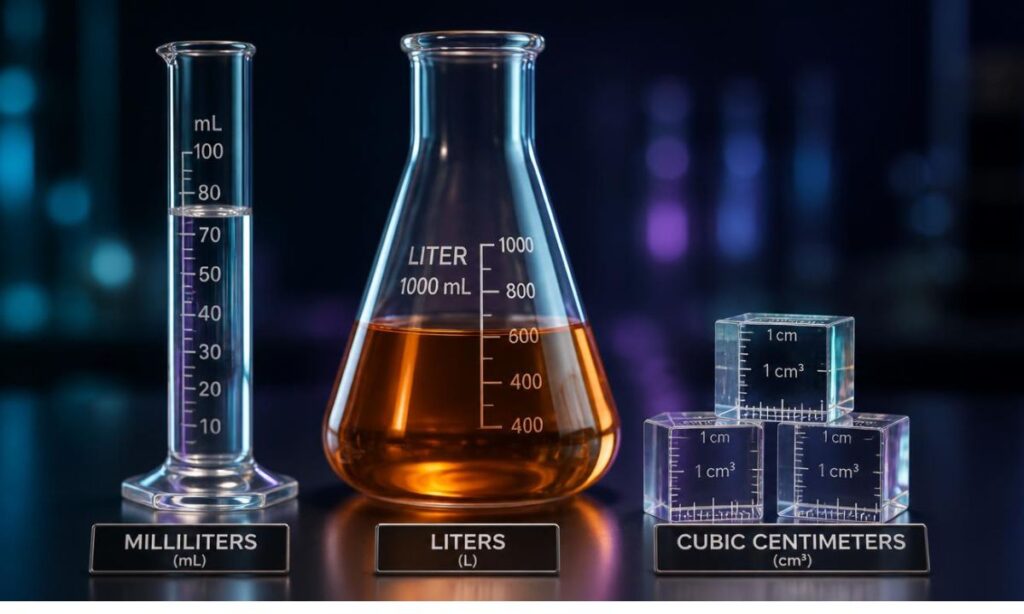
You may also see recipes or conversion tools using milliliters, liters, or cubic centimeters instead of cups.
For volume:
1 milliliter = 1 cubic centimeter (cm³)
And:
1000 milliliters = 1 liter
A metric cup is commonly treated as 250 milliliters, meaning:
1 metric cup = 250 ml = 250 cm³
Using that reference, 450 ml would equal:
450 ÷ 250 = 1.8 metric cups
But remember, 450 grams is not automatically 450 milliliters. That equivalence is approximately true for water, not for every ingredient. This distinction is small on paper and rather important in the kitchen.
Common Mistakes When Converting 450 Grams to Cups
One of the most common mistakes is assuming that grams and cups can be converted without knowing the ingredient. They cant, because one measures mass and the other measures volume.
Another mistake is using a water conversion for flour or sugar. Water has its own density, and applying it to another ingredient can create a substantial measurement error.
People also sometimes forget the difference between a US cup and a metric cup. It may not ruin every recipe, but precision baking can be less forgiving than everyday cooking.
Finally, measuring packed ingredients without realizing they are packed can change the result. Brown sugar is a classic example where the method of filling the cup matters.
Practical Tips for Accurate 450g Measurements
If you are converting 450 grams because a recipe only gives cup measurements, use an ingredient-specific reference whenever possible. A generic gram to cup converter is only as reliable as its density data.
For flour, avoid aggressively compressing it into the cup. For brown sugar, follow the recipe’s instructions about packing. For liquids, use a proper liquid measuring cup when appropriate.
And if you have a digital kitchen scale nearby, dont be shy about using it. In many cases, weighing 450 grams directly is faster than trying to make 3.6 cups of flour behave like an exact scientific measurement.
Read more : Convert Gram Into Liter
Frequently Asked Questions
450g to Cups for Water
450 grams of water is approximately 1.8 metric cups, using 250 grams per metric cup.
450g to Cups for Flour
450g of flour is roughly 3.5 to 3.6 cups, depending on how the flour is measured and packed.
450g to Cups for Sugar
450 grams of granulated sugar equals approximately 2.25 cups, based on about 200 grams per cup.
450g to Cups for Butter
450 grams of butter is approximately 2 cups, making this one of the easier kitchen conversions.
Conclusion
So, how many cups are in 450 grams? The honest answer is: it depends on what you are measuring.
Using the common reference of 250 grams per metric cup for water:
450 grams of water = 1.8 metric cups
For other ingredients, the approximate amounts can look very different. Around 450 grams of flour may be about 3.6 cups, while 450 grams of granulated sugar may be about 2.25 cups, and 450 grams of butter is close to 2 cups.
That difference is not a mistake. It is simply the result of density, which connects weight and volume.
If you’re converting a recipe, always identify the ingredient first, then check its grams-per-cup value and the cup standard being used. A little attention here saves the classic kitchen moment of staring at a bowl and wondering why the recipe somehow went sideways.
For the most accurate 450g to cups result, tell the converter or your measuring method the exact ingredient. Thats what turns a rough estimate into a useful kitchen measurement.