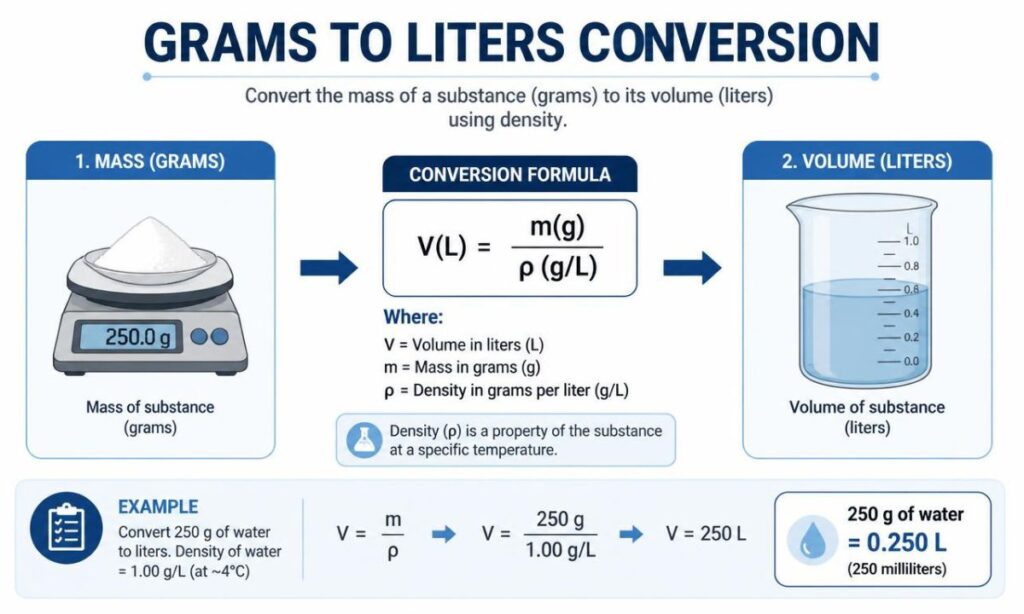
At first glance, trying to convert gram into liter looks like one of those tiny calculations that should take only a second. But there is a little catch hiding inside it: grams measure mass, while liters measure volume. So, unlike converting meters to centimeters, you cannot simply multiply or divide by a fixed number and expect the answer to work for everything.
The missing piece is density. Water, honey, flour, oil, sugar, and alcohol all occupy different amounts of space even when they have the same mass. That is why 1,000 grams of water is about 1 liter, while 1,000 grams of honey takes up considerably less space.
Once you understand that relationship, grams to liters conversion becomes much easier. You only need the mass of the substance and its density, then the conversion is pretty straightforward, more or less.
Can You Convert Grams to Liters Directly?
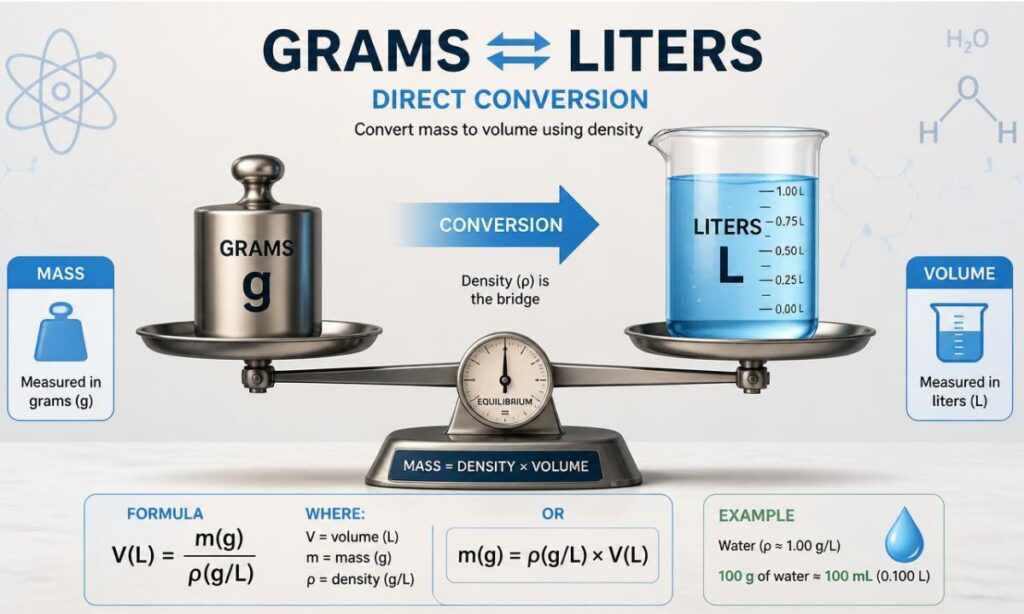
You can convert grams to liters, but you need to know the substance’s density first. A gram tells you how much matter there is by mass, whereas a liter tells you how much physical space that matter occupies.
For example, 1,000 grams of water is approximately 1 liter because water has a density close to 1,000 grams per liter. But 1,000 grams of glycerine does not equal 1 liter because glycerine is denser than water.
This is the basic idea behind mass to volume conversion. The substance matters, and this small detail is often missed when people search for a simple g to l conversion.
Grams to Liters Formula
The main grams to liters formula is:
Liters = Grams ÷ Density
Here, grams represent the mass, density is normally expressed in grams per liter (g/L), and liters represent the resulting volume.
For example, suppose you have 500 grams of water and use a density of 1,000 g/L:
Liters = 500 ÷ 1,000
Liters = 0.5 L
So, 500 grams of water is approximately 0.5 liters.
This formula is useful for cooking, laboratory measurements, food preparation, manufacturing, and everyday measurement conversion. The important thing is to use the correct density for the particular substance.
How to Convert Grams Into Liters Step by Step
The easiest way to calculate grams to liters is to follow a few simple steps. It sounds more technical than it really is, honestly.
- Find the mass of the substance in grams.
- Find the substance’s density in grams per liter.
- Divide the mass by the density.
- Write the result in liters.
- Check whether the result makes practical sense for the substance.
For example, imagine you have 2,000 grams of a substance with a density of 800 g/L.
Volume = 2,000 ÷ 800
Volume = 2.5 liters
Therefore, 2,000 grams of that substance occupies approximately 2.5 liters under the stated density conditions.
That last phrase matters. Density can change with temperature and other conditions, so a conversion is only as accurate as the density value being used.
Why Density Is Necessary
The reason you cannot simply say that 1 gram equals a certain number of liters is because different materials have different substance density.
Think about a bag of flour and a bottle of water. You could put 1,000 grams of each on a scale, and their masses would be identical. Yet they may occupy different volumes because flour has a much lower bulk density than water.
The same thing happens with honey, sugar, salt, and oils. A dense material packs more mass into a given volume, while a less dense material needs more space for the same mass.
In other words, density connects mass and volume. Once that connection is known, a grams to volume calculation becomes possible.
Grams to Liters for Water
Water is the easiest example because its commonly used density is approximately 1,000 g/L under typical reference conditions.
Using the formula:
Liters = Grams ÷ 1,000
That gives these useful examples:
| Water Mass | Approximate Volume |
|---|---|
| 100 grams | 0.1 liter |
| 250 grams | 0.25 liter |
| 500 grams | 0.5 liter |
| 750 grams | 0.75 liter |
| 1,000 grams | 1 liter |
| 2,000 grams | 2 liters |
| 5,000 grams | 5 liters |
So if someone asks how many liters is 1000 grams, the answer for water is approximately 1 liter.
But don’t carry that rule over to every ingredient. One liter of honey and one liter of water do not have the same mass, and that’s exactly where density earns its place.
100 Grams to Liters
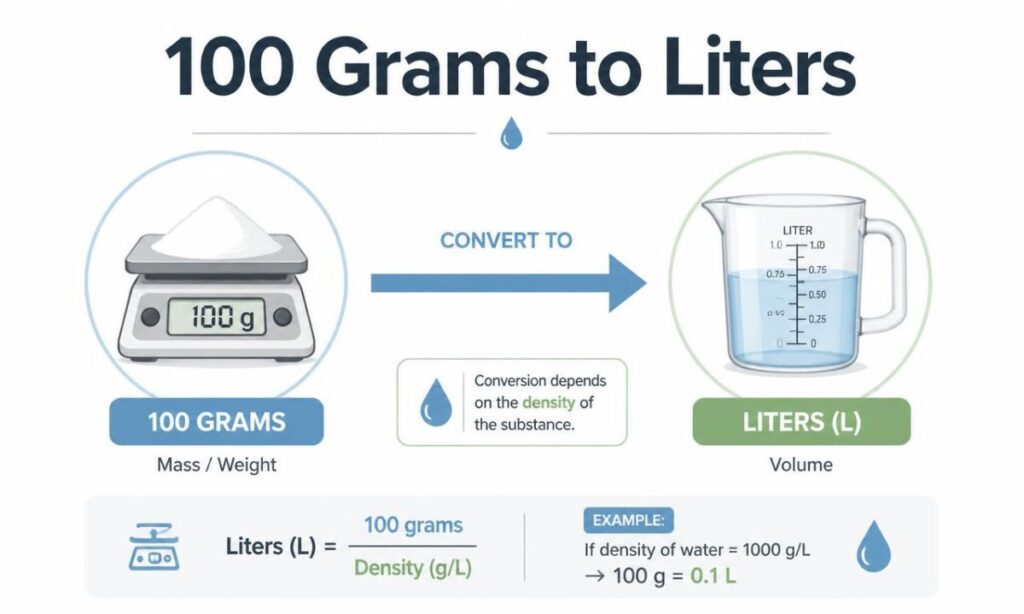
The answer to 100 grams to liters depends entirely on the material.
For water:
100 ÷ 1,000 = 0.1 L
So, 100 grams of water is approximately 0.1 liter, or 100 milliliters.
For a substance with a density of 800 g/L:
100 ÷ 800 = 0.125 L
The same 100 grams now occupies approximately 0.125 liters.
This simple example shows why a generic grams to liters converter must ask what substance you are converting. Without density, the result is incomplete.
500 Grams to Liters
Let’s use several examples to make the idea less slippery.
For water with a density of 1,000 g/L:
500 ÷ 1,000 = 0.5 L
So 500 grams of water = approximately 0.5 liters.
For a substance with a density of 700 g/L:
500 ÷ 700 ≈ 0.714 L
For a substance with a density of 1,400 g/L:
500 ÷ 1,400 ≈ 0.357 L
The numbers move around because the density ratio changes. That’s the whole secret behind converting mass into volume.
1000 Grams to Liters
People often search for 1000 grams to liters because 1,000 grams is equal to 1 kilogram. However, 1 kilogram is not automatically 1 liter.
For water:
1,000 g ÷ 1,000 g/L = 1 L
For honey:
1,000 g ÷ 1,400 g/L ≈ 0.714 L
For flour:
1,000 g ÷ 570 g/L ≈ 1.754 L
Notice the difference. A kilogram of flour can occupy substantially more space than a kilogram of honey. Same mass measurement, different volume.
Common Ingredient Grams to Liters Conversion
Kitchen ingredients are where this conversion becomes especially useful. Recipes frequently give ingredients in grams, while containers, jars, or measuring equipment may be marked in milliliters or liters.
Here are some approximate density values from the supplied reference data:
| Substance | Approx. Density | 1,000 g in Liters |
|---|---|---|
| Water | 1,000 g/L | 1.000 L |
| Acetone | 780 g/L | 1.282 L |
| Beer | 1,010 g/L | 0.990 L |
| Butter | 920 g/L | 1.087 L |
| Ethyl alcohol | 790 g/L | 1.266 L |
| Flour | 570 g/L | 1.754 L |
| Glycerine | 1,260 g/L | 0.794 L |
| Honey | 1,400 g/L | 0.714 L |
| Milk | 1,030 g/L | 0.971 L |
| Coconut oil | 920 g/L | 1.087 L |
| Palm oil | 910 g/L | 1.099 L |
| Sunflower oil | 920 g/L | 1.087 L |
These values are useful for estimation, but ingredients can vary. Flour especially can behave differently depending on how tightly it is packed, so a kitchen conversion isn’t always laboratory-perfect, and that’s normal.
Convert Flour Grams to Liters
Flour is a good example of why bulk density matters.
Using the reference density of approximately 570 g/L, the calculation is:
Liters = Grams ÷ 570
For 500 grams:
500 ÷ 570 ≈ 0.877 L
For 1,000 grams:
1,000 ÷ 570 ≈ 1.754 L
So 1,000 grams of flour would occupy approximately 1.75 liters using this density estimate.
Still, flour can be fluffy, compressed, sifted, or packed down. Because of that, a kitchen measuring cup may give a different practical result than a theoretical conversion calculator.
Convert Sugar Grams to Liters
Sugar also has different approximate densities depending on whether it is granulated, brown, or powdered.
Using the supplied reference values:
| Sugar Type | Density | 1,000 g ≈ |
|---|---|---|
| Beet sugar | 800 g/L | 1.250 L |
| Brown sugar | 720 g/L | 1.389 L |
| Granulated sugar | 700 g/L | 1.429 L |
| Powdered sugar | 560 g/L | 1.786 L |
For example, to convert sugar grams to liters using granulated sugar:
Liters = 1,000 ÷ 700
Liters ≈ 1.429 L
The difference between powdered and granulated sugar is a nice reminder that even closely related materials can have different density values.
Convert Honey Grams to Liters
Honey is denser than water, so a given mass of honey usually occupies less volume than the same mass of water.
Using a reference density of 1,400 g/L:
500 grams of honey = 500 ÷ 1,400
≈ 0.357 L
Therefore, 500 grams of honey is approximately 357 milliliters using that density.
For 1,000 grams:
1,000 ÷ 1,400 ≈ 0.714 L
So, 1,000 grams of honey ≈ 0.714 liters under this assumed density.
Actual honey density can vary with temperature and composition, so treat such values as practical estimates rather than an eternal number carved into stone.
Convert Milk Grams to Liters
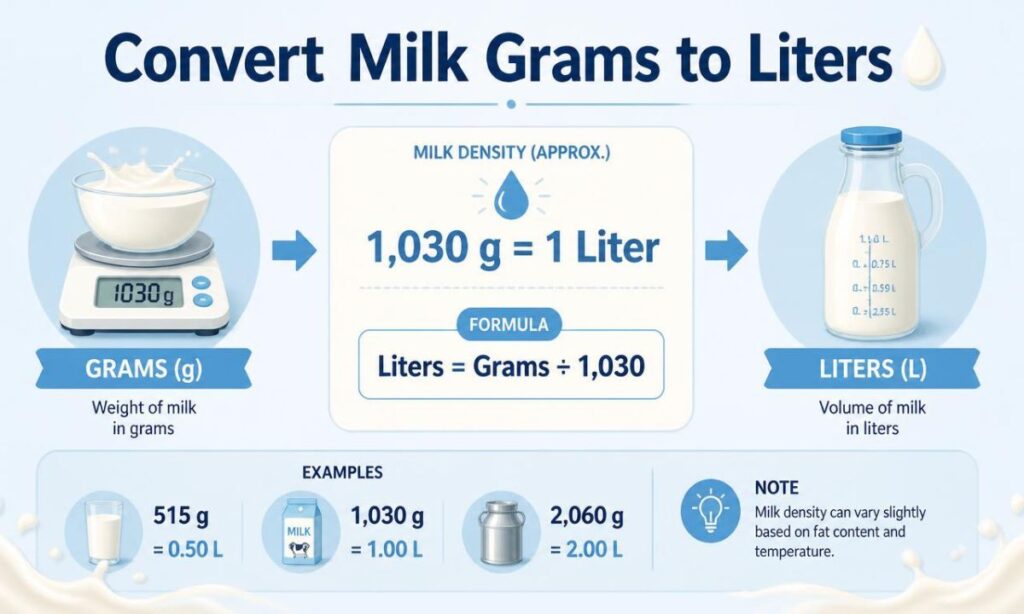
Milk is slightly denser than water in the reference data, at approximately 1,030 g/L.
To convert milk grams to liters:
Liters = Grams ÷ 1,030
For 500 grams:
500 ÷ 1,030 ≈ 0.485 L
For 1,000 grams:
1,000 ÷ 1,030 ≈ 0.971 L
So 1,000 grams of milk is approximately 0.971 liters according to that reference density.
For everyday cooking, the difference from 1 liter may be small enough for some recipes, but precise food production or scientific work may require a more exact density.
Convert Oil Grams to Liters
Oils are generally less dense than water. The supplied reference data gives approximately 920 g/L for coconut oil and sunflower oil, and 910 g/L for palm oil.
For 1,000 grams of sunflower oil:
1,000 ÷ 920 ≈ 1.087 L
For 1,000 grams of palm oil:
1,000 ÷ 910 ≈ 1.099 L
That means a kilogram of these oils can occupy slightly more than one liter.
Again, temperature is worth remembering because oils can expand or contract. A number from a chart is useful, but the actual substance in front of you may not behave exactly the same way.
Liters to Grams Formula
The reverse calculation is just as simple.
To convert liters to grams, use:
Grams = Liters × Density
Suppose you have 2 liters of water:
2 × 1,000 = 2,000 grams
So, 2 liters of water has a mass of approximately 2,000 grams.
For 2 liters of honey:
2 × 1,400 = 2,800 grams
That is why the answer to how many grams are in a liter depends on what is inside the liter. A liter is a volume measurement, not a fixed amount of mass.
1 Liter to Grams
For a substance with density of 1,000 g/L:
1 L × 1,000 g/L = 1,000 g
For a substance with density of 570 g/L:
1 L × 570 g/L = 570 g
For a substance with density of 1,400 g/L:
1 L × 1,400 g/L = 1,400 g
So 1 liter to grams is not one universal conversion. The density of the substance decides the answer.
2 Liters to Grams and 5 Liters to Grams
Once you know the density, larger conversions are easy.
For water:
2 liters × 1,000 g/L = 2,000 grams
5 liters × 1,000 g/L = 5,000 grams
For honey:
2 liters × 1,400 g/L = 2,800 grams
5 liters × 1,400 g/L = 7,000 grams
This is the reverse of grams to liters conversion, and both calculations rely on the same relationship between mass, volume, and density.
Grams and Liters: Understanding the Difference
The words grams and liters sometimes get treated like interchangeable units, but they describe different physical quantities.
Gram (g): measures mass.
Liter (L): measures volume.
Density: describes how much mass exists within a particular volume.
A liter is also equivalent to a cubic decimeter, which helps explain why it is a volume unit. Meanwhile, mass is connected to the amount of matter rather than the amount of space it fills.
Weight is related but isn’t technically identical to mass. Weight is a force affected by gravity, while mass remains a measure of matter. In ordinary kitchen conversations people often use “weight” for grams, and nobody usually objects, but the scientific distinction is still useful.
Grams to Liters Conversion Table
For quick calculations, this mini table can help when the substance is water:
| Grams | Water Volume |
|---|---|
| 100 g | 0.1 L |
| 200 g | 0.2 L |
| 300 g | 0.3 L |
| 400 g | 0.4 L |
| 500 g | 0.5 L |
| 750 g | 0.75 L |
| 1,000 g | 1 L |
| 2,000 g | 2 L |
| 5,000 g | 5 L |
This table works for water because the assumed density is approximately 1,000 g/L. It should not be used unchanged for flour, honey, sugar, oil, or other materials.
Using a Grams to Liters Converter
A grams to liters converter is basically a small calculator that applies the same density relationship for you.
A useful converter should ask for:
- The mass in grams
- The substance
- The density
- The desired volume unit
Then it applies:
Volume = Mass ÷ Density
For the reverse direction, a liters to grams converter uses:
Mass = Volume × Density
The calculator saves time, particularly when you have several quantities to convert. Still, understanding the underlying conversion formula is helpful because you can check whether a calculator’s result looks reasonable.
What Can Affect the Conversion?
Density isn’t always a perfectly fixed number. Temperature, atmospheric pressure, composition, and physical condition can affect measurements, especially with liquids and gases.
For many everyday cooking calculations, a standard density value is perfectly practical. Scientific or industrial work may require density measured under specific conditions.
Bulk materials have another complication: the way particles are arranged can change their apparent volume. Powdered salt, flour, and sugar can occupy different amounts of space depending on how tightly they’re packed.
So if two sources give slightly different density values, it doesn’t automatically mean one of them is wrong. The measurement conditions and material properties may simply differ.
Common Mistakes When Converting Grams Into Liters
One frequent mistake is assuming that 1,000 grams always equals 1 liter. That is approximately true for water under common reference conditions, but not for every substance.
Another mistake is using density in the wrong direction. To go from grams to liters, divide mass by density. To go from liters to grams, multiply volume by density.
People also sometimes confuse kilograms and grams. Since:
1 kilogram = 1,000 grams
you may need to convert kilograms into grams before using a density expressed in g/L.
Finally, don’t forget the units. Writing the calculation with units can catch surprisingly many little errors before they become big ones.
Quick Reference: The Two Essential Formulas
If you only remember two equations from this entire guide, make them these:
Grams to liters:
Liters = Grams ÷ Density
Liters to grams:
Grams = Liters × Density
Everything else is basically these two relationships wearing different clothes.
For example, if a substance has a density of 800 g/L and you have 1,600 grams:
1,600 ÷ 800 = 2 liters
If you instead have 2 liters:
2 × 800 = 1,600 grams
The calculations travel in opposite directions, but the relationship stays the same.
Frequently Asked Questions
gram to litre
To convert grams to litres, you need the substance’s density. Use the formula: Litres = Grams ÷ Density.
grams to liters calculator
A grams to liters calculator uses the mass in grams and the substance’s density to calculate its volume in litres quickly and accurately.
gram to liter
Gram to liter conversion depends on the material being measured because different substances have different densities. For example, 1,000 grams of water is approximately 1 liter.
grams to liters
To convert grams to liters, divide the number of grams by the density in grams per liter. This gives the volume of the substance in liters.
g to liters
g to liters means converting mass into volume. The basic formula is Liters = Grams ÷ Density, so you must know the substance’s density first.
Conclusion
Learning how to convert grams to liters becomes much less confusing once you stop looking for a single universal conversion number. Grams describe mass, liters describe volume, and density provides the bridge between them.
For water, the familiar relationship makes things wonderfully simple: around 1,000 grams is approximately 1 liter. For honey, flour, sugar, milk, oil, acetone, and other substances, the answer changes according to their density.
So whenever you need to convert gram into liter, first ask one small question: What substance am I measuring? Then find its density, apply liters = grams / density, and keep your units consistent.
Whether you’re measuring ingredients for a recipe, preparing a bulk product, checking a laboratory quantity, or simply wondering how many liters are in grams, the same principle will guide you. Once the density is known, the mystery mostly disappears and the calculation becomes pleasantly ordinary.